

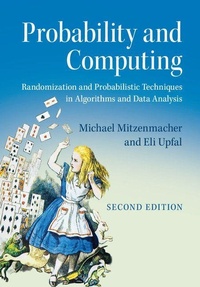
Probability and Computing
Randomization and Probabilistic Techniques in Algorithms and Data Analysis
2nd Edition
Published on 3. July 2017
Book
Hardback
484 pages
978-1-107-15488-9 (ISBN)
Description
Greatly expanded, this new edition requires only an elementary background in discrete mathematics and offers a comprehensive introduction to the role of randomization and probabilistic techniques in modern computer science. Newly added chapters and sections cover topics including normal distributions, sample complexity, VC dimension, Rademacher complexity, power laws and related distributions, cuckoo hashing, and the Lovasz Local Lemma. Material relevant to machine learning and big data analysis enables students to learn modern techniques and applications. Among the many new exercises and examples are programming-related exercises that provide students with excellent training in solving relevant problems. This book provides an indispensable teaching tool to accompany a one- or two-semester course for advanced undergraduate students in computer science and applied mathematics.
Reviews / Votes
'As randomized methods continue to grow in importance, this textbook provides a rigorous yet accessible introduction to fundamental concepts that need to be widely known. The new chapters in this second edition, about sample size and power laws, make it especially valuable for today's applications.' Donald E. Knuth, Stanford University, California 'Of all the courses I have taught at Berkeley, my favorite is the one based on the Mitzenmacher-Upfal book Probability and Computing. Students appreciate the clarity and crispness of the arguments and the relevance of the material to the study of algorithms. The new second edition adds much important material on continuous random variables, entropy, randomness and information, advanced data structures and topics of current interest related to machine learning and the analysis of large data sets.' Richard M. Karp, University of California, Berkeley 'The new edition is great. I'm especially excited that the authors have added sections on the normal distribution, learning theory and power laws. This is just what the doctor ordered or, more precisely, what teachers such as myself ordered!' Anna Karlin, University of Washington 'By assuming just an elementary introduction to discrete probability and some mathematical maturity, this book does an excellent job of introducing a great variety of topics to the reader. I especially liked the coverage of the Poisson, exponential, and (multi-variate) normal distributions and how they arise naturally, machine learning, Bayesian reasoning, Cuckoo hashing etc. There is a broad range of exercises, including helpful ones on programming to get a feel for the numerics ... This connection to practice is unusual and very commendable ... Overall, I would highly recommend this book to anyone interested in probabilistic and statistical foundations as applied to computer science, data science, etc. It can be taught at the senior undergraduate or graduate level to students in computer science, electrical engineering, operations research, mathematics, and other such disciplines.' Frederic Green , SIGACT NewsMore details
Edition
2nd Revised edition
Language
English
Place of publication
Cambridge
United Kingdom
Target group
College/higher education
Edition type
Revised edition
Illustrations
1 Tables, black and white; 8 Halftones, black and white
Dimensions
Height: 259 mm
Width: 182 mm
Thickness: 27 mm
Weight
1158 gr
ISBN-13
978-1-107-15488-9 (9781107154889)
Copyright in bibliographic data and cover images is held by Nielsen Book Services Limited or by the publishers or by their respective licensors: all rights reserved.
Schweitzer Classification
Other editions
Additional editions
Michael Mitzenmacher
Probability and Computing
Randomization and Probabilistic Techniques in Algorithms and Data Analysis
E-Book
07/2017
Cambridge University Press
€46.99
Available for download
Michael Mitzenmacher | Eli Upfal
Probability and Computing
Randomization and Probabilistic Techniques in Algorithms and Data Analysis
E-Book
06/2017
2nd Edition
Cambridge University Press
€55.99
Available for download
Previous edition
Michael Mitzenmacher | Eli Upfal
Probability and Computing
Randomized Algorithms and Probabilistic Analysis
Book
01/2005
Cambridge University Press
€68.08
Article exhausted; check for reprint
Persons
Michael Mitzenmacher is a Professor of Computer Science in the School of Engineering and Applied Sciences at Harvard University, Massachusetts. Professor Mitzenmacher has authored or co-authored over 200 conference and journal publications on a variety of topics, including algorithms for the internet, efficient hash-based data structures, erasure and error-correcting codes, power laws, and compression. His work on low-density parity-check codes shared the 2002 IEEE Information Theory Society Best Paper Award and won the 2009 ACM SIGCOMM Test of Time Award. He was elected as the Chair of the ACM Special Interest Group on Algorithms and Computation Theory in 2015. Eli Upfal is a Professor of Computer Science at Brown University, where he was also the department chair from 2002 to 2007. Prior to joining Brown in 1998, he was a researcher and project manager at the IBM Almaden Research Center, and a professor at the Weizmann Institute of Science, Israel. His main research interests are randomized algorithms, probabilistic analysis of algorithms, and computational statistics, with applications ranging from combinatorial and stochastic optimization, massive data analysis and sampling complexity to computational biology, and computational finance.
Content
1. Events and probability; 2. Discrete random variables and expectations; 3. Moments and deviations; 4. Chernoff and Hoeffding bounds; 5. Balls, bins, and random graphs; 6. The probabilistic method; 7. Markov chains and random walks; 8. Continuous distributions and the Polsson process; 9. The normal distribution; 10. Entropy, randomness, and information; 11. The Monte Carlo method; 12. Coupling of Markov chains; 13. Martingales; 14. Sample complexity, VC dimension, and Rademacher complexity; 15. Pairwise independence and universal hash functions; 16. Power laws and related distributions; 17. Balanced allocations and cuckoo hashing.