

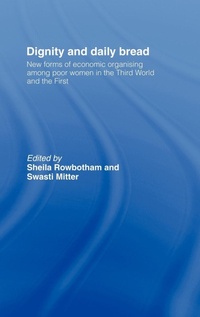
Dignity and Daily Bread
New Forms of Economic Organization Among Poor Women in the Third World and the First
Published on 9. December 1993
Book
Hardback
248 pages
978-0-415-09585-3 (ISBN)
Description
Dignity and Daily Bread compares the lives of women in the first and third worlds and examines how women have organized forms of production themselves. Covering a wide range of issues and areas, from cotton production in Bombay, conditions in Mexico and in some of the Far East economies, the contributors begin to break down some of the ideological barriers that colonialism and racism build among women. The immediacy of the accounts bring women's conditions in very different patriarchal societies to life, and underline the book's topicality in a time of global economic hardship. Dignity and Daily Bread will have considerable importance for women's studies and development studies.
More details
Language
English
Place of publication
London
United Kingdom
Publishing group
Taylor & Francis Ltd
Target group
College/higher education
Dimensions
Height: 240 mm
Width: 161 mm
Thickness: 18 mm
Weight
540 gr
ISBN-13
978-0-415-09585-3 (9780415095853)
Copyright in bibliographic data and cover images is held by Nielsen Book Services Limited or by the publishers or by their respective licensors: all rights reserved.
Schweitzer Classification
Other editions
Additional editions
Swasti Mitter | Sheila Rowbotham
Dignity and Daily Bread
New Forms of Economic Organization Among Poor Women in the Third World and the First
E-Book
09/2003
Routledge
€32.99
Available for download
Swasti Mitter | Sheila Rowbotham
Dignity and Daily Bread
New Forms of Economic Organization Among Poor Women in the Third World and the First
E-Book
09/2003
Routledge
€32.99
Available for download
Swasti Mitter | Sheila Rowbotham
Dignity and Daily Bread
New Forms of Economic Organization Among Poor Women in the Third World and the First
Book
12/1993
Routledge
€38.00
Shipment within 15-20 days
Persons
Sheila Rowbotham has a background in economic and labour history and is the author of several books including Women's Resistance and Revolution (1973), Women's Consciousness, Man's World (1973) and Women in Movement: Feminism and Social Action (Routledge 1993). Swasti Mitter is an economist who has written extensively on homework, women and technology. She has published many books including Common Fate, Common Bond: Women in the Global Economy (1986), and Computer-aided Manufacturing and Women's Employment: The Clothing Industry in Four EC countries (1992).
Content
Introduction 1 On organising women in casualised work: a global overview 2 Women in the Bombay cotton textile industry, 1919-1940 3 The conditions and organisational activities of women in Free Trade Zones: Malaysia, Philippines and Sri Lanka, 1970-1990 4 Weaving dreams, constructing realities: the Nineteenth of September National Union of Garment Workers in Mexico 5 Self-Employed Women's Association: organising women by struggle and development 6 Deindustrialisation and the growth of women's economic associations and networks in urban Tanzania 7 Strategies against sweated work in Britain, 1820-1920 8 Homework in West Yorkshire