

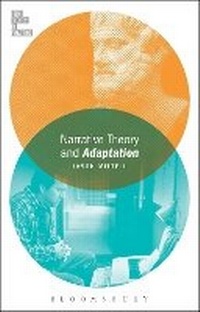
Narrative Theory and Adaptation.
Published on 20. April 2017
Book
Paperback/Softback
152 pages
978-1-5013-0840-6 (ISBN)
Description
Narrative Theory and Adaptation offers a concise introduction to narrative theory in jargon-free language and shows how this theory can be deployed to interpret Spike Jonze's critically acclaimed 2002 film Adaptation.
Understanding narrative theory is crucial to make sense of the award-winning film Adaptation. The book explicates, in clear prose for beginners, four key facets important to the narrative theory of film: the distinction between practical vs. critical theory, the role of adaptation, the process of narrative comprehension, and notions of authorship. It then works to unlock Adaptation using these four keys in succession, considering how the film demands a theoretical understanding of the storytelling process. In using this unusual case study of a film, the author makes the case for the importance of narrative theory as a general perspective for filmmakers, critics, and viewers alike.
Understanding narrative theory is crucial to make sense of the award-winning film Adaptation. The book explicates, in clear prose for beginners, four key facets important to the narrative theory of film: the distinction between practical vs. critical theory, the role of adaptation, the process of narrative comprehension, and notions of authorship. It then works to unlock Adaptation using these four keys in succession, considering how the film demands a theoretical understanding of the storytelling process. In using this unusual case study of a film, the author makes the case for the importance of narrative theory as a general perspective for filmmakers, critics, and viewers alike.
Reviews / Votes
Everything you always wanted to know about narrative theory, refracted through the ground-breaking, rule-breaking movie Adaptation. In Jason Mittell's hands, Spike Jonze's filming of Charlie (and his fictional brother Donald) Kaufman's screenplay of Susan Orlean's The Orchid Thief becomes a one-stop shopping mall that illuminates the relations between adaptation and authorship, the differences between performances and dramatizations of real people, the results of filmmakers sending up the very models and conventions they rely on, and the reasons why budding students of adaptation will be happily occupied even if no one ever makes another movie. * Thomas Leitch, Professor, University of Delaware, USA and editor of The Oxford Handbook of Adaptation Studies * Jason Mittell digs expertly into how and why cinematic stories are made, showing us the multiple relationships between narrative theory and artistic practice. The book illuminates character, structure, authorship, and the interpretive experience of film, using Adaptation. as an ideal test case. Mittell succeeds admirably in connecting the nitty-gritty to the conceptual, revealing that they are as intimately and provocatively intertwined as Charlie and Donald Kaufman. Anyone interested in the ecosystems of storytelling will find elucidation and intellectual rewards here. * Sean O'Sullivan, Associate Professor, Film Studies Program and Department of English, The Ohio State University, USA *More details
Series
Language
English
Place of publication
New York
United States
Publishing group
Bloomsbury Publishing Plc
Target group
Professional and scholarly
College/higher education
Dimensions
Height: 198 mm
Width: 124 mm
Thickness: 12 mm
Weight
200 gr
ISBN-13
978-1-5013-0840-6 (9781501308406)
Copyright in bibliographic data and cover images is held by Nielsen Book Services Limited or by the publishers or by their respective licensors: all rights reserved.
Schweitzer Classification
Other editions
Additional editions
Jason Mittell
Narrative Theory and Adaptation.
E-Book
04/2017
1st Edition
Bloomsbury Academic USA
€22.99
Available for download
Jason Mittell
Narrative Theory and Adaptation.
E-Book
04/2017
1st Edition
Bloomsbury Academic USA
€22.99
Available for download
Person
Jason Mittell is Professor of Film & Media Culture and American Studies at Middlebury College, USA. He is the author of Genre & Television: From Cop Shows to Cartoons in American Culture (2004), Television & American Culture (2009), Complex Television: The Poetics of Contemporary Television Storytelling (forthcoming), and co-editor of How to Watch Television (2013), as well as numerous essays about film and media studies. He runs the blog Just TV.
Content
Introduction
Chapter 1: Narrative Theory
Chapter 2: Narrative Theory and Adaptation
Conclusion
Further Reading
Chapter 1: Narrative Theory
Chapter 2: Narrative Theory and Adaptation
Conclusion
Further Reading