

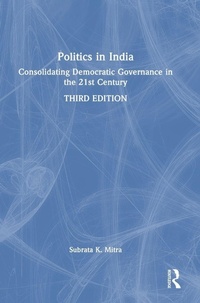
Politics in India
Consolidating Democratic Governance in the 21st Century
3rd Edition
Published on 13. May 2026
Book
Hardback
464 pages
978-1-032-70923-9 (ISBN)
Description
This third edition of Politics in India provides a timely counter-narrative to pessimistic prognoses about the future of Indian democracy. It focuses on the resilience of India's democratic political system and its strategic reorientation in response to electoral mandates emerging from the country's vigorously competitive elections.
In a comprehensive analysis of the country's democratic processes, Mitra brings together political theory and historical perspective in order to provide a comparative analysis and interpretation of issues that have occupied the Indian state since Independence from British colonial rule in 1947. Based on the rationality of the Indian voter and the strategic acumen of the political leaders, this is the first comprehensive explanation of how India has achieved a seamless transition from colonial rule to a robust and resilient democracy. Mitra explains how India has sought to balance development with social justice, consent with force, and pursue strategic autonomy in the global arena. As a result, the book demonstrates that, despite occasional breakdown of orderly rule, the political process consistently restores dynamic equilibrium of the system. The chapters, cross-referenced, can be read both as stand-alone essays on specific themes, as well as parts of a single narrative.
Supplemented with tables, boxes, illustrations, and comprehensive notes on further reading, the new edition will continue to be an essential reading for students and researchers in Indian and South Asian studies, introduction to political science and world politics, development studies, sociology, comparative politics, and political theory. General readers interested in how the world's most populous democracy functions on a day-to-day basis may find the volume a useful introduction to Indian politics.
In a comprehensive analysis of the country's democratic processes, Mitra brings together political theory and historical perspective in order to provide a comparative analysis and interpretation of issues that have occupied the Indian state since Independence from British colonial rule in 1947. Based on the rationality of the Indian voter and the strategic acumen of the political leaders, this is the first comprehensive explanation of how India has achieved a seamless transition from colonial rule to a robust and resilient democracy. Mitra explains how India has sought to balance development with social justice, consent with force, and pursue strategic autonomy in the global arena. As a result, the book demonstrates that, despite occasional breakdown of orderly rule, the political process consistently restores dynamic equilibrium of the system. The chapters, cross-referenced, can be read both as stand-alone essays on specific themes, as well as parts of a single narrative.
Supplemented with tables, boxes, illustrations, and comprehensive notes on further reading, the new edition will continue to be an essential reading for students and researchers in Indian and South Asian studies, introduction to political science and world politics, development studies, sociology, comparative politics, and political theory. General readers interested in how the world's most populous democracy functions on a day-to-day basis may find the volume a useful introduction to Indian politics.
Reviews / Votes
"Politics in India deftly lays out the choices, institutions, process as well as the deeper structures of society, history and culture shaping India's changing trajectory. It weaves together historical, and contemporary material including public opinion data to build a powerful framework that both surveys while also articulating a set of cogent ideas and concepts that allow us to see the changes and the continuities in India's trajectory of governance. This book educates the student and teacher but also goes beyond to stimulate the scholar of India. The guide to further reading in Chapter 17 enables the reader to go deep if they so choose. The writing is powerful and evocative. This textbook is valuable advance over previous editions and is likely to serve as an important resource for the un-initiated, as well as students, teachers and scholars alike."Aseema Sinha, Wagener Chair of South Asian Politics and George R. Roberts Fellow, Claremont McKenna College, California, USA
"This is the first-ever comprehensive book on Indian politics which surpasses all existing ones. Majestic in scope and style, it belongs to the grand tradition Lloyd and Susanne Rudolph. Based the application of political scientific tools - yet rare in the genre - it firmly roots understanding Indian politics in history, culture and context of the country. Mindful of the blemishes as well as achievements of the Indian state, the book focuses on India's resilient democracy, and indigeneity, adaptability and transformability of modern politics in a traditional setting. Original, and path breaking, the book will remain a standard text on Indian politics for students, researchers, rulers, political opinionmakers and the general readers."
Harihar Bhattacharyya, Ph. D (LSE), Former Professor of Political Science, the University of Burdwan
"Systematically exploring the institutional architecture and multifaceted socio-political processes, this volume offers us a deeply reflective and analytically sophisticated assessment of Indian politics. It unpacks the complexities of the contemporary political landscape to map out the dasha (status) and disha (direction) of constitutional democracy in India."
Hilal Ahmed, Professor, Centre for the Study of Developing Societies, New Delhi
More details
Edition
3rd edition
Language
English
Place of publication
London
United Kingdom
Publishing group
Taylor & Francis Ltd
Target group
College/higher education
Professional and scholarly
Postgraduate and Undergraduate Advanced
Product notice
sewn/stitched
Cloth over boards
Illustrations
36 s/w Photographien bzw. Rasterbilder, 2 s/w Zeichnungen, 66 s/w Tabellen, 38 s/w Abbildungen
66 Tables, black and white; 2 Line drawings, black and white; 36 Halftones, black and white; 38 Illustrations, black and white
Dimensions
Height: 244 mm
Width: 170 mm
Thickness: 27 mm
Weight
975 gr
ISBN-13
978-1-032-70923-9 (9781032709239)
Copyright in bibliographic data and cover images is held by Nielsen Book Services Limited or by the publishers or by their respective licensors: all rights reserved.
Schweitzer Classification
Other editions
Additional editions
E-Book
05/2026
3rd Edition
Routledge
€55.49
Available for download
E-Book
05/2026
3rd Edition
Routledge
€55.49
Available for download
Book
05/2026
3rd Edition
Routledge
€52.50
Shipment within 10-20 days
Previous edition
Book
11/2017
2nd Edition
Routledge
€252.55
Article exhausted; check for reprint
Person
Subrata K. Mitra was Head of the Department of Political Science at the South Asia Institute, Heidelberg University, Germany (1994-2014). In the course of his years in teaching, research, and academic collaboration, he has applied his specialisation in rational choice theory and quantitative methods to a diversity of fields which include Indian and comparative politics; democratisation; the post-colonial state and social change; governance; elections and political parties; state-formation and sub-national movements; foreign policy; religion and art history; and transcultural studies. This diversity can be seen in the range of his publications which include India: Statecraft and Foreign Policy (with Jivanta Schottli, and Markus Pauli, 2023), The 2019 Parliamentary Elections in India: Democracy at the Crossroads? (with Rekha Saxena and Pampa Mukherjee, 2022), 'The 2024 parliamentary elections in India: nation, region and religion' (with Harihar Bhattacharyya, forthcoming, 2026); Governance by Stealth: The Ministry of Home Affairs and the Making of the Indian State (2021); Kautilya's Arthashastra: An Intellectual Biography - the Classical Roots of Modern Politics in India (with Michael Liebig, 2017); Citizenship and the Flow of Ideas in the Era of Globalization (2012); Re-use: The Art and Politics of Integration and Anxiety (with Julia Hegewald, 2012); When Rebels Become Stakeholders (with V.B. Singh, 2009) and The Puzzle of India's Governance (2005).
Content
PART I: Introduction
1 Indian politics in the 21st century: democracy, diversity, and governance
2 The 'idioms' of Indian politics: culture, context, and the rational voter
PART II: History, society, and identity
3 The past in the making of the present: the longue duree of Indian politics
4 Caste, language, and religion: politics and social cleavages in India
5 Nationising India: politics in quest of a collective identity
PART III: Government and the political process
6 Strength with accountability: the institutional arrangement of the Indian state
7 India's symmetric and asymmetric federalism: balancing national unity and regional autonomy
8 Elections and political parties: democracy's workhorses
9 Radical politics, 'demand groups' and consolidation of democratic governance
10 Force in the making of legitimacy: the keepers of order, and the consolidation of Indian democracy
PART IV: Economy, social justice, and India's global outreach
11 The state and the economy: the challenge of democracy and development
12 The state and social justice: poverty, social vulnerability, and welfare
13 India and the world: statecraft and foreign policy
PART V: Conclusion: consolidating democratic governance
14 The resilience of India's counterfactual democracy, and its anomalies
15 Consolidating democratic governance in India: prospects and problems
Further reading
Appendix
Bibliography
Index
1 Indian politics in the 21st century: democracy, diversity, and governance
2 The 'idioms' of Indian politics: culture, context, and the rational voter
PART II: History, society, and identity
3 The past in the making of the present: the longue duree of Indian politics
4 Caste, language, and religion: politics and social cleavages in India
5 Nationising India: politics in quest of a collective identity
PART III: Government and the political process
6 Strength with accountability: the institutional arrangement of the Indian state
7 India's symmetric and asymmetric federalism: balancing national unity and regional autonomy
8 Elections and political parties: democracy's workhorses
9 Radical politics, 'demand groups' and consolidation of democratic governance
10 Force in the making of legitimacy: the keepers of order, and the consolidation of Indian democracy
PART IV: Economy, social justice, and India's global outreach
11 The state and the economy: the challenge of democracy and development
12 The state and social justice: poverty, social vulnerability, and welfare
13 India and the world: statecraft and foreign policy
PART V: Conclusion: consolidating democratic governance
14 The resilience of India's counterfactual democracy, and its anomalies
15 Consolidating democratic governance in India: prospects and problems
Further reading
Appendix
Bibliography
Index