

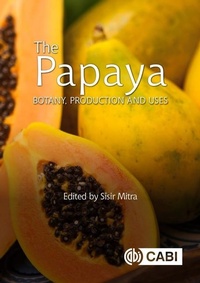
The Papaya
Botany, Production and Uses
Published on 11. September 2020
Book
Hardback
288 pages
978-1-78924-190-7 (ISBN)
Description
Papaya (Carica papaya) is an important and widely-cultivated tropical fruit, grown in more than 60 countries of the world. Global papaya production has grown significantly over the last few years, mainly as a result of increased production in India. Papaya has become an important agricultural export for developing countries where export revenues of the fruit provide a livelihood for thousands of people, especially in Asia and Latin America. This book includes coverage of recent research developments with the potential to improve crop yields and quality. New research has contributed to our understanding of the crop environment, plant growth and physiology of tree and fruit development with implications for both breeding and cultivation. It looks at how analysis of the papaya genome promises new, faster breeding techniques to improved cultivars and how these and other advances are helping to tackle disease like papaya ring spot viruses and major pests which cause significant losses. Key features include: updated information for sustainable papaya cultivation research developments in tackling the major production and post-harvest problems interdisciplinary and collaborative research With contributions from international experts, the book presents the current state of knowledge concerning the history, physiology, culture and marketing of papaya throughout the world. It is an essential resource for researchers, growers and all those involved in the papaya industry.
More details
Series
Language
English
Place of publication
Wallingford
United Kingdom
Target group
College/higher education
Professional and scholarly
Product notice
sewn/stitched
Cloth over boards
Dimensions
Height: 246 mm
Width: 175 mm
Thickness: 20 mm
Weight
898 gr
ISBN-13
978-1-78924-190-7 (9781789241907)
Copyright in bibliographic data and cover images is held by Nielsen Book Services Limited or by the publishers or by their respective licensors: all rights reserved.
Schweitzer Classification
Other editions
Additional editions

E-Book
09/2020
CABI Publishing
€139.99
Available for download
Persons
Sisir Mitra worked at the Bidhan Chandra Krishi Viswavidyalaya, Mohanpur, West Bengal, India from 1980 until 2014. He served as Head, Department of Fruits and Orchard Management (1996-2000), Dean, Faculty of Horticulture (2007-2009) and Dean, Post Graduate Studies (2009-2012). Dr Mitra did his post doctoral research (1985-1986) at the Horticulture Research International, East Malling, UK as Commonwealth Fellow and worked as visiting Professor at the Institute Coltivazoni Arboree, Italy (1990), and University of Lavras, Brazil (2016). He has published 266 scientific papers, 74 popular articles, 16 books, 1 IBPGR Descriptors and 28 technical reports. He has developed one coconut variety (Kalpa Mitra), two mango (Himsagar-HT 10 and Langra-LT 64 ) and three Jackfruit ( Jt-1, JT 39 and JT 40) clones. Dr Mitra served as Board Member responsible for publications of ISHS, Science Editor, ISHS and Editor-in-Chief, Fruits: The International Journal of Tropical and Subtropical Horticulture, Chairman, Editorial Advisory Board of Acta Horticulturae and Chronica Horticulturae. He is presently the Chairman, Working Group on Avocado, and Jackfruit and other Moraceae. Previously he was Chairman,Tropical and Subtropical Fruits. He is presently the Editor of CABI Concise series on 'Sustainable Horticulture for Nutritional Security and Economic Prosperity.'
Editor
Chair, Section Tropical and Subtropical Fruits, ISHSInternational Society for Horticultural Science, India
Contributions
University of Putra Malaysia
Unidad de Biotecnologia, Mexico
University of Florida, USA
Universidad de Costa Rica
Unidad de Biotecnologia, Mexico
National Pingtung University of Science and Technology, Taiwan
University of Hawaii at Manoa, Hawaii
National Pingtung University of Science and Technology, Taiwan
Content
1: Origin, History, Composition and Processing 2: Production and Trade 3: Taxonomy, Botany and Plant Development 4: Propagation 5: Biotechnology 6: Varieties and crop improvement 7: Nutrition and Irrigation 8: Plant Water Relations 9: Effects of Physiology and Growing Environment on Productivity 10: Flowering and Sex expression 11: Fruit set, development, maturity and ripening 12: Physiological disorders 13: Insect and Nematode Pests 14: Diseases 15: Greenhouse Cultivation 16: Postharvest Handling, Storage and Quality