

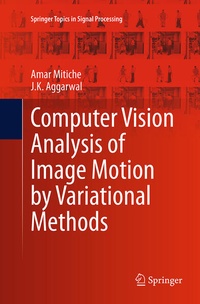
Computer Vision Analysis of Image Motion by Variational Methods
Published on 23. August 2016
Book
Paperback/Softback
VII, 207 pages
978-3-319-37547-2 (ISBN)
Description
This book presents a unified view of image motion analysis under the variational framework. Variational methods, rooted in physics and mechanics, but appearing in many other domains, such as statistics, control, and computer vision, address a problem from an optimization standpoint, i.e., they formulate it as the optimization of an objective function or functional. The methods of image motion analysis described in this book use the calculus of variations to minimize (or maximize) an objective functional which transcribes all of the constraints that characterize the desired motion variables. The book addresses the four core subjects of motion analysis: Motion estimation, detection, tracking, and three-dimensional interpretation. Each topic is covered in a dedicated chapter. The presentation is prefaced by an introductory chapter which discusses the purpose of motion analysis. Further, a chapter is included which gives the basic tools and formulae related to curvature, Euler Lagrange equations, unconstrained descent optimization, and level sets, that the variational image motion processing methods use repeatedly in the book.
More details
Series
Edition
Softcover reprint of the original 1st ed. 2014
Language
English
Place of publication
Cham
Switzerland
Publishing group
Springer International Publishing
Target group
Professional and scholarly
Illustrations
25 s/w Abbildungen, 29 farbige Abbildungen
VII, 207 p. 54 illus., 29 illus. in color.
Dimensions
Height: 235 mm
Width: 155 mm
Thickness: 12 mm
Weight
335 gr
ISBN-13
978-3-319-37547-2 (9783319375472)
DOI
10.1007/978-3-319-00711-3
Schweitzer Classification
Other editions
Additional editions
Amar Mitiche | J.K. Aggarwal
Computer Vision Analysis of Image Motion by Variational Methods
Book
09/2013
1st Edition
Springer
€106.99
Shipment within 10-15 days
Content
Image Motion Processing in Visual Function.- Background Preliminaries.- Optical Flow Estimation.- Motion Detection.- Tracking.- Optical Flow Three-Dimensional Interpretation.