

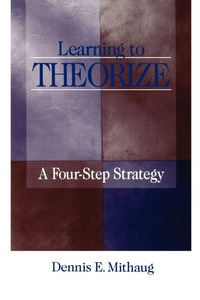
Learning to Theorize
A Four-Step Strategy
1st Edition
Published on 24. August 2000
Book
Paperback/Softback
200 pages
978-0-7619-0980-4 (ISBN)
Description
This book describes a constructive theorizing strategy that graduate students and applied searchers can use to improve their beliefs about contemporary social problems. Throughout the use of compelling questions and examples, Mithaug shows readers how to implement this (four-step) strategy to construct explanations for uncertainties about how things work, how they ought to work and what should be done about them. He begins the book with an explanation of the practical features of constructive theorizing and shows how it mirrors general problem solving, practical reasoning, and self-regulated learning. He then demonstrates how to separate the facts, values, and actions of a situation in order to clarify and understand their relationship as well as how a thinking strategy assists in learning to theorize better. This book will enable readers to separate questions of fact, value, and action; explain their differences and similarities; and summarize their explanations in a theory that reconstructs those facts, values, and actions in a more credible and valuable way.
More details
Language
English
Place of publication
Thousand Oaks
United States
Target group
Professional and scholarly
Dimensions
Height: 229 mm
Width: 152 mm
Thickness: 11 mm
Weight
298 gr
ISBN-13
978-0-7619-0980-4 (9780761909804)
Copyright in bibliographic data and cover images is held by Nielsen Book Services Limited or by the publishers or by their respective licensors: all rights reserved.
Schweitzer Classification
Other editions
Additional editions
Book
08/2000
1st Edition
SAGE Publications Inc
€218.30
Shipment within 15-20 days
Content
Knowing What to Believe
Constructing Credible and Valuable Beliefs
Empirical Theorizing about Facts
Moral Theorizing about Values
Policy Theorizing about Actions
Conclusion
Constructing Credible and Valuable Beliefs
Empirical Theorizing about Facts
Moral Theorizing about Values
Policy Theorizing about Actions
Conclusion