

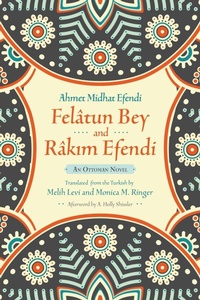
Felatun Bey and Rakim Efendi
An Ottoman Novel
Published on 31. March 2016
Book
Paperback/Softback
208 pages
978-0-8156-1064-9 (ISBN)
Description
Ahmet Midhat Efendi's famous 1875 novel Felatun Bey and Rakim Efendi takes place in late nineteenth-century Istanbul and follows the lives of two young men who come from radically different backgrounds. Rakim Efendi is an erudite, self-made man, one who is ambitious and cultivated enough to mingle with a European crowd. In contrast, Felatun Bey is a spendthrift who lacks intellectual curiosity and a strong work ethic. Squandering his wealth and education, he leads a life of decadence.
The novel traces Rakim and Felatun's relationships with multiple characters, charting their romances and passions, as well as their foibles and amusing mishaps as they struggle to find and follow their own path through the many temptations and traps of European culture. The author creates a rich portrait of stratified Ottoman life through a diverse and colorful cast of characters-from a French piano teacher and an Arab nanny, to a Circassian slave girl-each deftly navigating the shifting mores of their social class. Written during the Ottoman Empire's uneasy transition to modernity, the novel's protagonists embody both the best and worst elements of two worlds, European and Ottoman. The novel provides readers with an elegant yet powerful appeal for progressive reforms and individual freedoms. Levi and Ringer's fluid translation of this Ottoman classic stands as a landmark in the history of Turkish literature in translation.
The novel traces Rakim and Felatun's relationships with multiple characters, charting their romances and passions, as well as their foibles and amusing mishaps as they struggle to find and follow their own path through the many temptations and traps of European culture. The author creates a rich portrait of stratified Ottoman life through a diverse and colorful cast of characters-from a French piano teacher and an Arab nanny, to a Circassian slave girl-each deftly navigating the shifting mores of their social class. Written during the Ottoman Empire's uneasy transition to modernity, the novel's protagonists embody both the best and worst elements of two worlds, European and Ottoman. The novel provides readers with an elegant yet powerful appeal for progressive reforms and individual freedoms. Levi and Ringer's fluid translation of this Ottoman classic stands as a landmark in the history of Turkish literature in translation.
Reviews / Votes
"One of the earliest examples of the Ottoman novel and it is today seen by many as the representative work of its era...it is undoubtedly a fascinating historical artefact."- Times Literary Supplement
More details
Series
Language
English
Place of publication
New York
United States
Product notice
Paperback (trade)
Unsewn / adhesive bound
Dimensions
Height: 229 mm
Width: 152 mm
Thickness: 11 mm
Weight
295 gr
ISBN-13
978-0-8156-1064-9 (9780815610649)
Copyright in bibliographic data and cover images is held by Nielsen Book Services Limited or by the publishers or by their respective licensors: all rights reserved.
Schweitzer Classification
Persons
Ahmet Midhat Efendi (1844-1912) was a journalist, novelist, playwright, translator, and social critic who authored more than two hundred original works. He wrote for and edited the Tercuemani Hakikat, the most influential and longest-running Ottoman newspaper.
Melih Levi received his BA from Amherst College, where he studied English literature.
Monica M. Ringer is professor of Middle Eastern history at Amherst College, USA. She is the author of Pious Citizens: Reforming Zoroastrianism in India and Iran.
Melih Levi received his BA from Amherst College, where he studied English literature.
Monica M. Ringer is professor of Middle Eastern history at Amherst College, USA. She is the author of Pious Citizens: Reforming Zoroastrianism in India and Iran.