

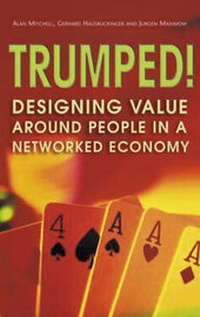
Trumped!
Designing Value around People in a Networked Economy
Published on 1. February 2020
Book
Hardback
256 pages
978-0-00-257153-1 (ISBN)
Description
What does it really mean to be consumer-driven? This title provides insight into the growing need for businesses to organize their operations around the needs of people (both customers and employees). A new superbreed of consumer-driven companies are combining the best of modern retailing and manufacturing in a clash of business models which is sparking radical changes and winning these "powerhouses" considerable competitive edge. As a fledgling buisness in 1969, Gap made most of its money by selling Levi's jeans. In 1984 it started developing its own Gap line and now the two brands are deadly enemies, battling it out for the same consumers' preference, loyalty and cash. "Powerhouse" companies such as Gap are pushing the boundaries of leading-edge practice and organizations like M&S, Tesco and Coca-Cola are having to re-invent what it means to be "consumer-driven". This book explains how leading companies are shifting the goalposts to reach new levels of performance accross all key areas, including staff motivation, real-time responsiveness to changing consumer needs, brand-building, IT, e-commerce and strategic alliances.
Using case studies such as 7-11 Japan, Adidas, Aldi, Hennes and Mauritz, Kellogg, Lufthansa, Procter and Gamble, Tesco and VW, including interviews with senior executives, the authors have provided an in-depth study of the contenders for 21st-century powerhouse status. They reveal how these organizations are maximizing alternative ways of going to market and explore the burgeoning power of the database and the emergence of the Internet and interactive TV.
What does it really mean to be consumer-driven? This title provides insight into the growing need for businesses to organize their operations around the needs of people (both customers and employees). A new superbreed of consumer-driven companies are combining the best of modern retailing and manufacturing in a clash of business models which is sparking radical changes and winning these "powerhouses" considerable competitive edge. As a fledgling buisness in 1969, Gap made most of its money by selling Levi's jeans. In 1984 it started developing its own Gap line and now the two brands are deadly enemies, battling it out for the same consumers' preference, loyalty and cash. "Powerhouse" companies such as Gap are pushing the boundaries of leading-edge practice and organizations like M&S, Tesco and Coca-Cola are having to re-invent what it means to be "consumer-driven". This book explains how leading companies are shifting the goalposts to reach new levels of performance accross all key areas, including staff motivation, real-time responsiveness to changing consumer needs, brand-building, IT, e-commerce and strategic alliances.
Using case studies such as 7-11 Japan, Adidas, Aldi, Hennes and Mauritz, Kellogg, Lufthansa, Procter and Gamble, Tesco and VW, including interviews with senior executives, the authors have provided an in-depth study of the contenders for 21st-century powerhouse status. They reveal how these organizations are maximizing alternative ways of going to market and explore the burgeoning power of the database and the emergence of the Internet and interactive TV.
Using case studies such as 7-11 Japan, Adidas, Aldi, Hennes and Mauritz, Kellogg, Lufthansa, Procter and Gamble, Tesco and VW, including interviews with senior executives, the authors have provided an in-depth study of the contenders for 21st-century powerhouse status. They reveal how these organizations are maximizing alternative ways of going to market and explore the burgeoning power of the database and the emergence of the Internet and interactive TV.
What does it really mean to be consumer-driven? This title provides insight into the growing need for businesses to organize their operations around the needs of people (both customers and employees). A new superbreed of consumer-driven companies are combining the best of modern retailing and manufacturing in a clash of business models which is sparking radical changes and winning these "powerhouses" considerable competitive edge. As a fledgling buisness in 1969, Gap made most of its money by selling Levi's jeans. In 1984 it started developing its own Gap line and now the two brands are deadly enemies, battling it out for the same consumers' preference, loyalty and cash. "Powerhouse" companies such as Gap are pushing the boundaries of leading-edge practice and organizations like M&S, Tesco and Coca-Cola are having to re-invent what it means to be "consumer-driven". This book explains how leading companies are shifting the goalposts to reach new levels of performance accross all key areas, including staff motivation, real-time responsiveness to changing consumer needs, brand-building, IT, e-commerce and strategic alliances.
Using case studies such as 7-11 Japan, Adidas, Aldi, Hennes and Mauritz, Kellogg, Lufthansa, Procter and Gamble, Tesco and VW, including interviews with senior executives, the authors have provided an in-depth study of the contenders for 21st-century powerhouse status. They reveal how these organizations are maximizing alternative ways of going to market and explore the burgeoning power of the database and the emergence of the Internet and interactive TV.
More details
Language
English
Place of publication
London
United Kingdom
Publishing group
HarperCollins Publishers
Target group
College/higher education
Professional and scholarly
Product notice
Library binding
Dimensions
Height: 234 mm
Width: 153 mm
ISBN-13
978-0-00-257153-1 (9780002571531)
Copyright in bibliographic data and cover images is held by Nielsen Book Services Limited or by the publishers or by their respective licensors: all rights reserved.
Schweitzer Classification
Persons
Alan Mitchell is former marketing correspondent of The Times and former editor of Marketing magazine. He writes for Marketing Week, Marketing Business, Management Today and the FT and is the author of two Financial Times Management Reports. Gerhard Hausruckinger and Jurgen Maximow are both partnerswith Roland Berger & Partner, Europe's largest management consultancy firm.
Alan Mitchell is former marketing correspondent of The Times and former editor of Marketing magazine. He writes for Marketing Week, Marketing Business, Management Today and the FT and is the author of two Financial Times Management Reports. Gerhard Hausruckinger and Jurgen Maximow are both partnerswith Roland Berger & Partner, Europe's largest management consultancy firm.
Alan Mitchell is former marketing correspondent of The Times and former editor of Marketing magazine. He writes for Marketing Week, Marketing Business, Management Today and the FT and is the author of two Financial Times Management Reports. Gerhard Hausruckinger and Jurgen Maximow are both partnerswith Roland Berger & Partner, Europe's largest management consultancy firm.