

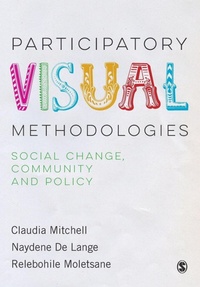
Participatory Visual Methodologies
Social Change, Community and Policy
1st Edition
Published on 6. October 2017
Book
Paperback/Softback
248 pages
978-1-4739-4731-3 (ISBN)
Description
This book demonstrates how data from participatory visual methods can take people and communities beyond ideological engagement, initiating new conversations and changing perspectives, policy debates, and policy development. These methods include, for example, photo-voice, participatory video, drawing/mapping, and digital storytelling.
Organised around a series of tools that have been used across health, education, environmental, and sociological research, Participatory Visual Methodologies illustrates how to maintain participant engagement in decision-making, navigate critical issues around ethics, track policies, and maximize the potential of longitudinal studies. Tools discussed include:
Pedagogical screenings
Digital dialogue devices
Upcycling and 'speaking back' interventions
Participant-led policy briefs
An authoritative and accessible guide to how participatory visual methods and arts-based methods can influence social change, this book will help any postgraduate researcher looking to contribute to policy dialogue.
Organised around a series of tools that have been used across health, education, environmental, and sociological research, Participatory Visual Methodologies illustrates how to maintain participant engagement in decision-making, navigate critical issues around ethics, track policies, and maximize the potential of longitudinal studies. Tools discussed include:
Pedagogical screenings
Digital dialogue devices
Upcycling and 'speaking back' interventions
Participant-led policy briefs
An authoritative and accessible guide to how participatory visual methods and arts-based methods can influence social change, this book will help any postgraduate researcher looking to contribute to policy dialogue.
Reviews / Votes
This powerful book brings together rich insights from participatory visual studies, reflexivity, and audience studies--a must for anyone wishing to engage in meaningful participatory research. -- Lindsey McCarthy A vital resource for researchers and practitioners working across disciplines. This book is simultaneously a valuable synthesis of existing knowledge in the area and an important building block for the continued development of this field of inquiry. -- Ioana Literat The book presents an invaluable resource for researchers using visual methods. It expands the field of participatory visual methods by providing a critical and rich perspective on its potential to impact policy-making processes. With over a decade of experience of working together in this field the authors are uniquely placed to make this contribution, as they critically engage in issues of power, ethics and representation. -- Verena ThomasMore details
Edition
First Edition
Language
English
Place of publication
London
United Kingdom
Target group
College/higher education
Professional and scholarly
Dimensions
Height: 244 mm
Width: 170 mm
Thickness: 14 mm
Weight
435 gr
ISBN-13
978-1-4739-4731-3 (9781473947313)
Copyright in bibliographic data and cover images is held by Nielsen Book Services Limited or by the publishers or by their respective licensors: all rights reserved.
Schweitzer Classification
Other editions
Additional editions
Claudia Mitchell | Naydene DeLange | Relebohile Moletsane
Participatory Visual Methodologies
Social Change, Community and Policy
Book
10/2017
1st Edition
SAGE Publications Ltd
€178.20
Shipment within 15-20 days
Claudia Mitchell | Naydene De Lange | Relebohile Moletsane
Participatory Visual Methodologies
Social Change, Community and Policy
E-Book
09/2017
1st Edition
SAGE Publications Ltd
€85.49
Available for download
Persons
Claudia Mitchell is a James McGill Professor in the Faculty of Education, McGill University where she is the Director of the McGill Institute for Human Development and Well-being and the founder and Director of the Participatory Cultures Lab. She is an Honorary Professor in the School of Education, University of KwaZulu-Natal, South Africa. She was the 2016 recipient of the Social Sciences and Humanities Research Council Gold Medal awarded for the impact of her research which cuts across a number of areas including girlhood studies, youth, sexuality, and HIV and AIDS, gender violence, and teacher identity, and in a number of countries including Canada, South Africa, Russia, Ethiopia, and Kenya . As a methodologist she is particularly interested in participatory visual research, memory work and material culture, and autoethnography. Naydene de Lange is Emeritus Professor in the Faculty of Education at the Nelson Mandela Metropolitan University, Port Elizabeth, South Africa. She previously held the HIV and AIDS Education Research Chair in the Faculty of Education at the same university. Her research focuses on using participatory visual methodologies in addressing gender and HIV&AIDS issues, and integrating HIV&AIDS into Higher Education curricula. Relebohile Moletsane is Professor and the John Langalibalele Dube Chair in Rural Education in the School of Education, University of KwaZulu-Natal in Durban, South Africa. Her areas of research include curriculum studies, rural education, gender and education, sexual and reproductive health education, girlhood studies and girls education in Southern African contexts. She is the Co-PI (with Claudia Mitchell, McGill University) on the Networks for Change and Wellbeing project (Networks for Change and Well-being (www.networks4change.co.za/). The project uses participatory visual methodologies, including photo-voice, participatory video (cellphilm), digital storytelling and drawing to address sexual violence with girls in rural KwaZulu-Natal.
Content
Chapter 1: Introduction: A Framework for Social Change through Participatory Visual Research
Introduction
Policy, Policy, Policy
Community and Policy Dialogue
Critical Audience Engagement
Overview of the Book
Key Points of the Chapter
Chapter 2: Project Design: Beginning with the End in Mind
Introduction
Research Design for Social Change
Participatory Visual Methods
A Case Study: Addressing Campus-based Sexual Violence
Conclusion
Key Points of the Chapter
Chapter 3: Speaking Back as Method
Introduction
Defining Speaking Back
On Using Speaking Back as Method
Features of Speaking Back as Method
Conclusion
Key Points of the Chapter
Chapter 4: Pictures at an Exhibition
Introduction
Community-Based Exhibitions
Processes in Curating
Studying Exhibiting
One Set of Photos, Multiple Showings
Method: Studying Audience Engagement
Studying Audiences through Exhibiting
Exhibition Catalogues
Creating an Exhibition Catalogue
Drawings: Collections and Catalogues
Conclusion
Key Points of the Chapter
Chapter 5: The Pedagogy of Screenings
Introduction
Why a Pedagogy of Screenings?
Methodologies for Screening
Researchers Screening their Own Productions
Researchers Screening Videos Made by Participants
Participants Screening their Own Work
Online Platforms and Screening
Discussion
Conclusion
Key Points of the Chapter
Chapter 6: Digital Artefacts: Researcher-Led Tools for Dialogue
Introduction
Research-Produced Digital Artefacts: A Brief History
Research-Produced Digital Dialogue Tools: Three Cases
A Co-Production: Researchers and Teachers Working Together on a 'Re-mix' Video
Digital Artefacts: Issues to Consider
Researcher Reflexivity/Discussion
Conclusion
Key Points of the Chapter
Chapter 7: Engaging Policy Makers
Introduction
Participant-led Tools for Engaging Policy makers
Taking Research to Policymakers
Using Participatory Video to Engage Policy Makers
Studying Pathways to Impact
Conclusion
Key Points of the Chapter
Chapter 8: What Difference Does This Make?
Introduction
Theories of Change
Tracking Change
Interpretive and Ethnographic Approaches
Conclusion
Key Points of the Chapter
Introduction
Policy, Policy, Policy
Community and Policy Dialogue
Critical Audience Engagement
Overview of the Book
Key Points of the Chapter
Chapter 2: Project Design: Beginning with the End in Mind
Introduction
Research Design for Social Change
Participatory Visual Methods
A Case Study: Addressing Campus-based Sexual Violence
Conclusion
Key Points of the Chapter
Chapter 3: Speaking Back as Method
Introduction
Defining Speaking Back
On Using Speaking Back as Method
Features of Speaking Back as Method
Conclusion
Key Points of the Chapter
Chapter 4: Pictures at an Exhibition
Introduction
Community-Based Exhibitions
Processes in Curating
Studying Exhibiting
One Set of Photos, Multiple Showings
Method: Studying Audience Engagement
Studying Audiences through Exhibiting
Exhibition Catalogues
Creating an Exhibition Catalogue
Drawings: Collections and Catalogues
Conclusion
Key Points of the Chapter
Chapter 5: The Pedagogy of Screenings
Introduction
Why a Pedagogy of Screenings?
Methodologies for Screening
Researchers Screening their Own Productions
Researchers Screening Videos Made by Participants
Participants Screening their Own Work
Online Platforms and Screening
Discussion
Conclusion
Key Points of the Chapter
Chapter 6: Digital Artefacts: Researcher-Led Tools for Dialogue
Introduction
Research-Produced Digital Artefacts: A Brief History
Research-Produced Digital Dialogue Tools: Three Cases
A Co-Production: Researchers and Teachers Working Together on a 'Re-mix' Video
Digital Artefacts: Issues to Consider
Researcher Reflexivity/Discussion
Conclusion
Key Points of the Chapter
Chapter 7: Engaging Policy Makers
Introduction
Participant-led Tools for Engaging Policy makers
Taking Research to Policymakers
Using Participatory Video to Engage Policy Makers
Studying Pathways to Impact
Conclusion
Key Points of the Chapter
Chapter 8: What Difference Does This Make?
Introduction
Theories of Change
Tracking Change
Interpretive and Ethnographic Approaches
Conclusion
Key Points of the Chapter