

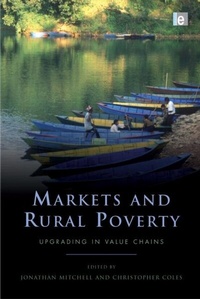
Markets and Rural Poverty
Upgrading in Value Chains
1st Edition
Published on 26. July 2011
Book
Hardback
292 pages
978-1-84971-313-9 (ISBN)
Description
This book explores the place of poor people within a rich variety of value chains, focusing upon lagging, rural regions in Africa and Asia, and how they can 'upgrade' within such chains. Upgrading is a key concept for value chain analysis and refers to the acquisition of technological capabilities and market linkages that enable firms to improve their competitiveness and move into higher-value activities.
The authors examine a range of evidence to assess whether the 'bottom billion' people, living mainly in the rural areas of low-income countries, can improve their position through productive strategies and, if so, how? They propose an innovative conceptual framework of value chain upgrading for some of the most marginal producers in the poorest local economies. They demonstrate how interventions can improve poverty and the environment for poor people supplying a wide range of services and agricultural and food products to local, regional and global markets.
This analysis is based on empirical research conducted in Senegal, Mali, Tanzania, India, Nepal, Philippines and Vietnam. The main focus is on poverty, environment and gender outcomes of upgrading interventions, and represents one of the key challenges of contemporary development economics.
The authors examine a range of evidence to assess whether the 'bottom billion' people, living mainly in the rural areas of low-income countries, can improve their position through productive strategies and, if so, how? They propose an innovative conceptual framework of value chain upgrading for some of the most marginal producers in the poorest local economies. They demonstrate how interventions can improve poverty and the environment for poor people supplying a wide range of services and agricultural and food products to local, regional and global markets.
This analysis is based on empirical research conducted in Senegal, Mali, Tanzania, India, Nepal, Philippines and Vietnam. The main focus is on poverty, environment and gender outcomes of upgrading interventions, and represents one of the key challenges of contemporary development economics.
More details
Language
English
Place of publication
London
United Kingdom
Publishing group
Taylor & Francis Ltd
Target group
College/higher education
Dimensions
Height: 229 mm
Width: 156 mm
Weight
612 gr
ISBN-13
978-1-84971-313-9 (9781849713139)
Copyright in bibliographic data and cover images is held by Nielsen Book Services Limited or by the publishers or by their respective licensors: all rights reserved.
Schweitzer Classification
Other editions
Additional editions
E-Book
09/2013
1st Edition
Routledge
€97.49
Available for download
E-Book
09/2013
1st Edition
Routledge
€97.49
Available for download

Book
07/2011
Routledge
€94.28
Article exhausted; check different version
Persons
Jonathan Mitchell is a Head of Programme at the Overseas Development Institute in London, working in the areas of agricultural development, business development and pro-poor tourism. He is a co-author of 'Tourism and Poverty Reduction' (Earthscan, 2010).
Christopher Coles is a Research Officer at the Overseas Development Institute, working in area of value chain analysis in a range of product and service markets, certification and market development.
Christopher Coles is a Research Officer at the Overseas Development Institute, working in area of value chain analysis in a range of product and service markets, certification and market development.
Content
1. Poverty, Agency and Value Chains 2. A Methodology for Integrating Developmental Concerns into Value Chain Analysis and Interventions 3. Summaries of the Seven Action Research Projects 4. Working Together - Horizontal Coordination as an Upgrading Strategy 5. Going for Win-Win - Upgrading through Vertical Coordination 6. Doing Different Things - Functional Upgrading 7. Better Quality and Working Smarter - Product and Process Upgrading 8. Skills Transfer - Inter-chain Upgrading 9. Who Runs this Place? The External Enabling Environment for Value Chain Development 10. Conclusions