

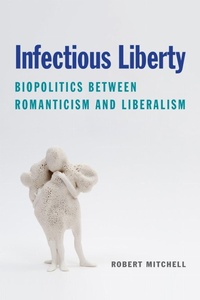
Infectious Liberty
Biopolitics Between Romanticism and Liberalism
Published on 13. April 2021
Book
Hardback
304 pages
978-0-8232-9458-9 (ISBN)
Description
Infectious Liberty traces the origins of our contemporary concerns about public health, world population, climate change, global trade, and government regulation to a series of Romantic-era debates and their literary consequences. Through a series of careful readings, Robert Mitchell shows how a range of elements of modern literature, from character-systems to free indirect discourse, are closely intertwined with Romantic-era liberalism and biopolitics.
Eighteenth- and early-nineteenth century theorists of liberalism such as Adam Smith and Thomas Malthus drew upon the new sciences of population to develop a liberal biopolitics that aimed to coordinate differences among individuals by means of the culling powers of the market. Infectious Liberty focuses on such authors as Mary Shelley and William Wordsworth, who drew upon the sciences of population to develop a biopolitics beyond liberalism. These authors attempted what Roberto Esposito describes as an "affirmative" biopolitics, which rejects the principle of establishing security by distinguishing between valued and unvalued lives, seeks to support even the most abject members of a population, and proposes new ways of living in common.
Infectious Liberty expands our understandings of liberalism and biopolitics-and the relationship between them-while also helping us to understand better the ways creative literature facilitates the project of reimagining what the politics of life might consist of.
Infectious Liberty is available from the publisher on an open-access basis.
Eighteenth- and early-nineteenth century theorists of liberalism such as Adam Smith and Thomas Malthus drew upon the new sciences of population to develop a liberal biopolitics that aimed to coordinate differences among individuals by means of the culling powers of the market. Infectious Liberty focuses on such authors as Mary Shelley and William Wordsworth, who drew upon the sciences of population to develop a biopolitics beyond liberalism. These authors attempted what Roberto Esposito describes as an "affirmative" biopolitics, which rejects the principle of establishing security by distinguishing between valued and unvalued lives, seeks to support even the most abject members of a population, and proposes new ways of living in common.
Infectious Liberty expands our understandings of liberalism and biopolitics-and the relationship between them-while also helping us to understand better the ways creative literature facilitates the project of reimagining what the politics of life might consist of.
Infectious Liberty is available from the publisher on an open-access basis.
More details
Series
Edition
New edition
Language
English
Place of publication
New York
United States
Target group
Professional and scholarly
Edition type
New edition
Product notice
Cloth over boards
Illustrations
9 b/w illustrations
Dimensions
Height: 235 mm
Width: 157 mm
Thickness: 24 mm
Weight
700 gr
ISBN-13
978-0-8232-9458-9 (9780823294589)
Copyright in bibliographic data and cover images is held by Nielsen Book Services Limited or by the publishers or by their respective licensors: all rights reserved.
Schweitzer Classification
Other editions
Additional editions
E-Book
04/2021
1st Edition
Fordham University Press
€27.99
Available for download
Person
Robert Mitchell is Chair of English at Duke University, where he also directs the Center for Interdisciplinary Studies in Science and Cultural Theory. His most recent book, Experimental Life: Vitalism in Romantic Science and Literature, won the Michelle Kendrick Memorial Book Prize and the BSLS Book Prize.
Content
Preface vii
Introduction 1
Part I: Romanticism, Biopolitics, and Literary Concepts
1. Biopolitics, Populations, and the Growth of Genius 23
2. Imagining Population in the Romantic Era: Frankenstein, Books, and Readers 50
3. Freed Indirect Discourse: Biopolitics, Population, and the Nineteenth-Century Novel 77
Part II: Romanticism and the Operations of Biopolitics
4. Building Beaches: Global Flows, Romantic-Era Terraforming, and the Anthropocene 113
5. Liberalism and the Concept of the Collective Experiment 148
6. Life, Self-Regulation, and the Liberal Imagination 186
Acknowledgments 231
Notes 233
Works Cited 291
Index 313
Introduction 1
Part I: Romanticism, Biopolitics, and Literary Concepts
1. Biopolitics, Populations, and the Growth of Genius 23
2. Imagining Population in the Romantic Era: Frankenstein, Books, and Readers 50
3. Freed Indirect Discourse: Biopolitics, Population, and the Nineteenth-Century Novel 77
Part II: Romanticism and the Operations of Biopolitics
4. Building Beaches: Global Flows, Romantic-Era Terraforming, and the Anthropocene 113
5. Liberalism and the Concept of the Collective Experiment 148
6. Life, Self-Regulation, and the Liberal Imagination 186
Acknowledgments 231
Notes 233
Works Cited 291
Index 313