

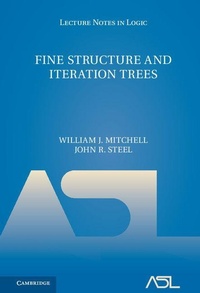
Fine Structure and Iteration Trees
Published on 2. March 2017
Book
Hardback
136 pages
978-1-107-16909-8 (ISBN)
Description
Since their inception, the Perspectives in Logic and Lecture Notes in Logic series have published seminal works by leading logicians. Many of the original books in the series have been unavailable for years, but they are now in print once again. In this volume, the third publication in the Lecture Notes in Logic series, Mitchell and Steel construct an inner model with a Woodin cardinal and develop its fine structure theory. This work builds upon the existing theory of a model of the form L[E], where E is a coherent sequence of extenders, and relies upon the fine structure theory of L[E] models with strong cardinals, and the theory of iteration trees and 'backgrounded' L[E] models with Woodin cardinals. This work is what results when fine structure meets iteration trees.
More details
Series
Language
English
Place of publication
Cambridge
United Kingdom
Target group
Professional and scholarly
Illustrations
1 Line drawings, black and white
Dimensions
Height: 235 mm
Width: 157 mm
Thickness: 12 mm
Weight
361 gr
ISBN-13
978-1-107-16909-8 (9781107169098)
Copyright in bibliographic data and cover images is held by Nielsen Book Services Limited or by the publishers or by their respective licensors: all rights reserved.
Schweitzer Classification
Other editions
Additional editions
William J. Mitchell | John R. Steel
Fine Structure and Iteration Trees
E-Book
03/2017
Cambridge University Press
€112.99
Available for download
Persons
William J. Mitchell works in the Department of Mathematics at the University of Florida. John R. Steel works in the Department of Mathematics at the University of California, Los Angeles.
Content
Introduction; 1. Good extender sequences; 2. Fine structure; 3. Squashed mice; 4. Ultrapowers; 5. Iteration trees; 6. Uniqueness of wellfounded branches; 7. The comparison process; 8. Solidarity and condensation; 9. Uniqueness of the next extender; 10. Closure under initial segment; 11. The construction; 12. Iterability; References; Index of definitions; Index.