

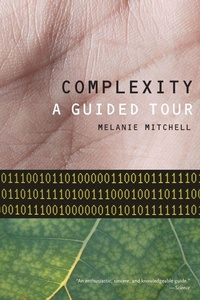
Complexity
A Guided Tour
Published on 24. November 2011
Book
Paperback/Softback
368 pages
978-0-19-979810-0 (ISBN)
Description
What enables individually simple insects like ants to act with such precision and purpose as a group? How do trillions of neurons produce something as extraordinarily complex as consciousness? In this remarkably clear and companionable book, leading complex systems scientist Melanie Mitchell provides an intimate tour of the sciences of complexity, a broad set of efforts that seek to explain how large-scale complex, organized, and adaptive behavior can emerge from simple interactions among myriad individuals. Based on her work at the Santa Fe Institute and drawing on its interdisciplinary strategies, Mitchell brings clarity to the workings of complexity across a broad range of biological, technological, and social phenomena, seeking out the general principles or laws that apply to all of them. Richly illustrated, Complexity: A Guided Tour--winner of the 2010 Phi Beta Kappa Book Award in Science--offers a wide-ranging overview of the ideas underlying complex systems science, the current research at the forefront of this field, and the prospects for its contribution to solving some of the most important scientific questions of our time.
Reviews / Votes
Melanie Mitchell's book is most enjoyable, truly inspiring, skillfully written, and, above all, beautifully clear. The author's enthusiasm and passion for the field make the book fascinating to read. Her rigor, clarity, and healthy skepticism make the book sound and the field scientifically stronger. It is an excellent and rigorous account of the scientific field of complexity. She proves by example that it is possible to explain complex systems science with rigor, breadth, depth, and- above all-exquisite clarity. * Artificial Life *More details
Language
English
Place of publication
New York
United States
Target group
College/higher education
Popular science readers, scientists interested in complexity studies
Illustrations
60 illustrations
Dimensions
Height: 234 mm
Width: 156 mm
Thickness: 22 mm
Weight
623 gr
ISBN-13
978-0-19-979810-0 (9780199798100)
Copyright in bibliographic data and cover images is held by Nielsen Book Services Limited or by the publishers or by their respective licensors: all rights reserved.
Schweitzer Classification
Other editions
Additional editions
Book
05/2009
Oxford University Press Inc
€40.70
Shipment within 15-20 days
E-Book
04/2009
1st Edition
OUP eBook
€22.49
Available for download
Person
Melanie Mitchell is Professor of Computer Science at Portland State University and External Professor at the Santa Fe Institute.
Content
Preface
Acknowledgments
Part I: Background and History
Chapter 1: What is Complexity?
Chapter 2: Dynamics, Chaos, and Prediction
Chapter 3: Information
Chapter 4: Computation
Chapter 5: Evolution
Chapter 6: Genetics, Simplified
Chapter 7: Defining and Measuring Complexity
Part II: Life and Evolution in Computers
Chapter 8: Self-Reproducing Programs
Chapter 9: Genetic Algorithms
Part III: Computation Writ Large
Chapter 10: Cellular Automata, Life, and the Universe
Chapter 11: Computing with Particles
Chapter 12: Information Processing in Living Systems
Chapter 13: How to Make Analogies (If You Are A Computer)
Chapter 14: Prospects of Computer Modeling
Part IV: Network Thinking
Chapter 15: The Science of Networks
Chapter 16: Applying Network Science to Real-World Networks
Chapter 17: The Mystery of Scaling
Chapter 18: Evolution, Complexified
Part V: Conclusion
Chapter 19: The Past and Future of the Sciences of Complexity
Notes
Bibliography
Index
Acknowledgments
Part I: Background and History
Chapter 1: What is Complexity?
Chapter 2: Dynamics, Chaos, and Prediction
Chapter 3: Information
Chapter 4: Computation
Chapter 5: Evolution
Chapter 6: Genetics, Simplified
Chapter 7: Defining and Measuring Complexity
Part II: Life and Evolution in Computers
Chapter 8: Self-Reproducing Programs
Chapter 9: Genetic Algorithms
Part III: Computation Writ Large
Chapter 10: Cellular Automata, Life, and the Universe
Chapter 11: Computing with Particles
Chapter 12: Information Processing in Living Systems
Chapter 13: How to Make Analogies (If You Are A Computer)
Chapter 14: Prospects of Computer Modeling
Part IV: Network Thinking
Chapter 15: The Science of Networks
Chapter 16: Applying Network Science to Real-World Networks
Chapter 17: The Mystery of Scaling
Chapter 18: Evolution, Complexified
Part V: Conclusion
Chapter 19: The Past and Future of the Sciences of Complexity
Notes
Bibliography
Index