

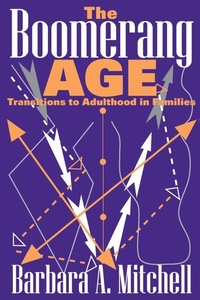
The Boomerang Age
Transitions to Adulthood in Families
1st Edition
Published on 15. December 2006
Book
Paperback/Softback
240 pages
978-0-202-30978-1 (ISBN)
Description
* The Boomerang Age was named an Outstanding Academic Title of 2007 by Choice Magazine.
Domestic changes are taking place in the lives of young adults in Western industrialized societies. Today's young people often experience less permanency and more movement in a variety of family-related roles, statuses, and living arrangements. Among the most prominent changes is the phenomenon of "boomerang kids," young adults returning to the parental home after their initial entrance into the adult world. The Boomerang Age, explores the implications of this development in a changing sociocultural, economic, and demographic landscape.
Mitchell begins by addressing definitional, conceptual, and measurement issues relevant to the "boomerang age." She then places the issues in historical perspective by considering trends in family organization--the nuclear family, marriage and divorce rates and fertility--over the past hundred years with emphasis on the 1950s family as a cultural benchmark. The book then turns to the contemporary trajectory of home leaving and returning, analyzing the "launch" and return phases with regard to economic factors, regional differences, and racial and ethnic backgrounds.
Mitchell then explores the more personal dimensions of how a return to the family is complicated by partnership (marriage, divorce, cohabitation, homosexuality) and parenthood among young couples. Moving outside the home, she looks at how public issues such as globalization, the decline of the welfare state, and various forms of social inequality affect the circumstances of young adulthood. Here Mitchell offers specific social policy recommendations pertaining to education, housing and dependency issues, childcare, and gender and racial equality. The book concludes by critically evaluating the advantages and drawbacks of two possible future scenarios: increased individualization in the pursuit of social goals, or a more or less permanent return to the traditional, extended family.
Domestic changes are taking place in the lives of young adults in Western industrialized societies. Today's young people often experience less permanency and more movement in a variety of family-related roles, statuses, and living arrangements. Among the most prominent changes is the phenomenon of "boomerang kids," young adults returning to the parental home after their initial entrance into the adult world. The Boomerang Age, explores the implications of this development in a changing sociocultural, economic, and demographic landscape.
Mitchell begins by addressing definitional, conceptual, and measurement issues relevant to the "boomerang age." She then places the issues in historical perspective by considering trends in family organization--the nuclear family, marriage and divorce rates and fertility--over the past hundred years with emphasis on the 1950s family as a cultural benchmark. The book then turns to the contemporary trajectory of home leaving and returning, analyzing the "launch" and return phases with regard to economic factors, regional differences, and racial and ethnic backgrounds.
Mitchell then explores the more personal dimensions of how a return to the family is complicated by partnership (marriage, divorce, cohabitation, homosexuality) and parenthood among young couples. Moving outside the home, she looks at how public issues such as globalization, the decline of the welfare state, and various forms of social inequality affect the circumstances of young adulthood. Here Mitchell offers specific social policy recommendations pertaining to education, housing and dependency issues, childcare, and gender and racial equality. The book concludes by critically evaluating the advantages and drawbacks of two possible future scenarios: increased individualization in the pursuit of social goals, or a more or less permanent return to the traditional, extended family.
More details
Language
English
Place of publication
Somerset
United States
Publishing group
Taylor & Francis Inc
Target group
College/higher education
Professional and scholarly
Dimensions
Height: 229 mm
Width: 152 mm
Thickness: 13 mm
Weight
354 gr
ISBN-13
978-0-202-30978-1 (9780202309781)
Copyright in bibliographic data and cover images is held by Nielsen Book Services Limited or by the publishers or by their respective licensors: all rights reserved.
Schweitzer Classification
Other editions
Additional editions
Book
07/2017
1st Edition
Routledge
€132.40
Shipment within 10-20 days
E-Book
07/2017
Routledge
€44.99
Available for download
E-Book
07/2017
Routledge
€44.99
Available for download
Person
Barbara Mitchell
Content
1. Introduction and Overview
2. In Theoretical Perspective: The Life Course Approach
3. Family Transitions in Historical Perspective
4. Leaving the Parental Home:
Homeleavers, Mature Coresiders and Boomerang Kids
5. Partners and Parenthood: Family Formation and
Dissolution Transitions of Young Adults
6. Through a Policy Lens: Social Policy and Social Action
in the Boomerang Age
7. Back to the Future-Is the Boomerang Age
Here to Stay?
References
Index
2. In Theoretical Perspective: The Life Course Approach
3. Family Transitions in Historical Perspective
4. Leaving the Parental Home:
Homeleavers, Mature Coresiders and Boomerang Kids
5. Partners and Parenthood: Family Formation and
Dissolution Transitions of Young Adults
6. Through a Policy Lens: Social Policy and Social Action
in the Boomerang Age
7. Back to the Future-Is the Boomerang Age
Here to Stay?
References
Index