

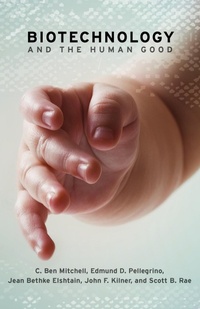
Biotechnology and the Human Good
Published on 23. April 2007
Book
Paperback/Softback
224 pages
978-1-58901-138-0 (ISBN)
Description
Some of humankind's greatest tools have been forged in the research laboratory. Who could argue that medical advances like antibiotics, blood transfusions, and pacemakers have not improved the quality of people's lives? But with each new technological breakthrough there comes an array of consequences, at once predicted and unpredictable, beneficial and hazardous. Outcry over recent developments in the reproductive and genetic sciences has revealed deep fissures in society's perception of biotechnical progress. Many are concerned that reckless technological development, driven by consumerist impulses and greedy entrepreneurialism, has the potential to radically shift the human condition - and not for the greater good. "Biotechnology and the Human Good" builds a case for a stewardship deeply rooted in Judeo-Christian theism to responsibly interpret and assess new technologies in a way that answers this concern. The authors jointly recognize humans not as autonomous beings but as ones accountable to each other, to the world they live in, and to God.
They argue that to question and critique how fields like cybernetics, nanotechnology, and genetics might affect our future is not anti-science, anti-industry, or anti-progress, but rather a way to promote human flourishing, common sense, and good stewardship. A synthetic work drawing on the thought of a physician, ethicists, and a theologian, "Biotechnology and the Human Good" reminds us that although technology is a powerful and often awe-inspiring tool, it is what lies in the heart and soul of who wields this tool that truly makes the difference in our world.
They argue that to question and critique how fields like cybernetics, nanotechnology, and genetics might affect our future is not anti-science, anti-industry, or anti-progress, but rather a way to promote human flourishing, common sense, and good stewardship. A synthetic work drawing on the thought of a physician, ethicists, and a theologian, "Biotechnology and the Human Good" reminds us that although technology is a powerful and often awe-inspiring tool, it is what lies in the heart and soul of who wields this tool that truly makes the difference in our world.
Reviews / Votes
"Moves the ethical debate over biotechnology to a new level. Biotechnology and the Human Good offers a critical analysis and constructive engagement that is informed, astute, and elegant. A must-read for anyone concerned about the prospect of a posthuman future." --Brent Waters, associate professor of Christian social ethics and director, Stead Center for Ethics and Values, Garrett-Evangelical Theological Seminary "United by their conviction that traditional Christianity must respond to the latest conundrums of biomedical research, the authors of Biotechnology and the Human Good write with clarity and passion. They are cautious without being negative, quite willing to endorse all the genuine benefits of biomedical science but wary of its prospects for remaking human nature. They warn that secular arguments against enhancement won't restrain our enthusiasm to make ourselves more than human. They insist that only a theology that sees humanity as created and redeemed by God will equip us to resist the temptation to re-create and improve ourselves. Not everyone will share their concerns, but everyone will be enriched by the cogency of their arguments and the clear theological framework they develop." --Ronald Cole-Turner, H. Parker Sharp Professor of Theology and Ethics, Pittsburgh Theological SeminaryMore details
Language
English
Place of publication
Washington, DC
United States
Target group
Professional and scholarly
US School Grade: College Graduate Student and over
Product notice
Paperback (trade)
Illustrations
Not illustrated
Dimensions
Height: 215 mm
Width: 181 mm
Thickness: 16 mm
Weight
290 gr
ISBN-13
978-1-58901-138-0 (9781589011380)
Copyright in bibliographic data and cover images is held by Nielsen Book Services Limited or by the publishers or by their respective licensors: all rights reserved.
Schweitzer Classification
Other editions
Additional editions
C. Ben Mitchell
Biotechnology and the Human Good
E-Book
04/2007
Georgetown University Press
€35.99
Available for download
Persons
C. Ben Mitchell is associate professor of bioethics and contemporary culture at Trinity International University. Edmund D. Pellegrino, MD, is the chair of the President's Council on Bioethics, and professor emeritus of medicine and medical ethics, Center for Clinical Bioethics, Georgetown University Medical Center. Jean Bethke Elshtain is the Laura Spelman Rockefeller Professor of Social and Political Ethics in the Divinity School at the University of Chicago. John F. Kilner is the Franklin Forman Chair of Ethics, professor of bioethics and contemporary culture, and the director of the bioethics program at Trinity International University. Scott B. Rae is professor of biblical studies and Christian ethics at Biola University.
Content
Preface Acknowledgments ONEThe Rapidly Changing World of Biotechnology TWOHumanity and the Technological Narrative THREEBiotechnology and Competing Worldviews FOURBiotechnology and Human Dignity FIVEBiotechnology and the Quest for Control SIXBiotechnology, Human Enhancement, and the Ends of Medicine SEVENConclusion: Toward a Foundation for Biotechnology Notes Authors and Collaborators Index