

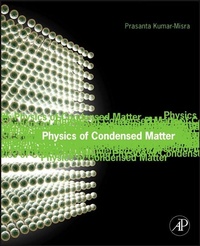
Physics of Condensed Matter
Published on 26. January 2011
Book
Hardback
688 pages
978-0-12-384954-0 (ISBN)
Description
Physics of Condensed Matter is designed for a two-semester graduate course on condensed matter physics for students in physics and materials science. While the book offers fundamental ideas and topic areas of condensed matter physics, it also includes many recent topics of interest on which graduate students may choose to do further research. The text can also be used as a one-semester course for advanced undergraduate majors in physics, materials science, solid state chemistry, and electrical engineering, because it offers a breadth of topics applicable to these majors.
The book begins with a clear, coherent picture of simple models of solids and properties and progresses to more advanced properties and topics later in the book. It offers a comprehensive account of the modern topics in condensed matter physics by including introductory accounts of the areas of research in which intense research is underway. The book assumes a working knowledge of quantum mechanics, statistical mechanics, electricity and magnetism and Green's function formalism (for the second-semester curriculum).
The book begins with a clear, coherent picture of simple models of solids and properties and progresses to more advanced properties and topics later in the book. It offers a comprehensive account of the modern topics in condensed matter physics by including introductory accounts of the areas of research in which intense research is underway. The book assumes a working knowledge of quantum mechanics, statistical mechanics, electricity and magnetism and Green's function formalism (for the second-semester curriculum).
Reviews / Votes
"This book, with reasonable size, gives a general view of the physics of condensed matter with two main purposes in mind: firstly, to display a coherent and clear picture of classical simple models of crystalline solids, and secondly, to introduce modern topics in a form as simple as possible. It is written in eighteen chapters which are almost self-contained. Furthermore, all keywords of condensed matter are dealt with and expanded in a detailed manner: crystals, phonons, electrons, solids, semiconductors, electronics, spintronics, diamagnetism, paramagnetism, superconductivity, fermions, nanoclusters. This is a standard textbook designed for a one- or two-semester graduate course." --Zentralblatt MATH 1222-1More details
Language
English
Place of publication
San Diego
United States
Publishing group
Elsevier Science Publishing Co Inc
Target group
College/higher education
Graduate students and advanced undergraduate students doing research in condensed matter physics, materials science, solid state chemistry and solid-state areas of electrical engineering.
Product notice
Unsewn / adhesive bound
Paper over boards
Illustrations
Approx. 100 illustrations
Dimensions
Height: 244 mm
Width: 202 mm
Thickness: 37 mm
Weight
1558 gr
ISBN-13
978-0-12-384954-0 (9780123849540)
Copyright in bibliographic data and cover images is held by Nielsen Book Services Limited or by the publishers or by their respective licensors: all rights reserved.
Schweitzer Classification
Other editions
Additional editions
Prasanta Kumar Misra | Prasanta Misra
Physics of Condensed Matter
E-Book
01/2011
Academic Press
€62.99
Available for download
Content
Chapter 1. Basic Properties of CrystalsChapter 2. Phonons and Lattice VibrationsChapter 3. Free Electron ModelChapter 4. Nearly Free Electron ModelChapter 5. Band Structure CalculationsChapter 6. Static and Transport Properties of SolidsChapter 7. Electron-Electron InteractionChapter 8. Dynamics of Bloch ElectronsChapter 9. SemiconductorsChapter 10. ElectronicsChapter 11. SpintronicsChapter 12. Diamagnetism and ParamagnetismChapter 13. Magnetic Ordering Chapter 14. SuperconductivityChapter 15. Heavy FermionsChapter 16. Metallic NanoclustersChapter 17. Complex StructuresChapter 18. Novel MaterialsAppendix A. Space Groups and Point GroupsAppendix B. Mossbauer EffectAppendix C. Introduction to Renormalization Group Approach