

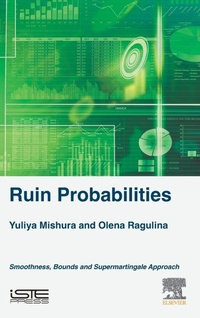
Ruin Probabilities
Smoothness, Bounds, Supermartingale Approach
Published on 10. October 2016
Book
Hardback
276 pages
978-1-78548-218-2 (ISBN)
Description
Ruin Probabilities: Smoothness, Bounds, Supermartingale Approach deals with continuous-time risk models and covers several aspects of risk theory. The first of them is the smoothness of the survival probabilities. In particular, the book provides a detailed investigation of the continuity and differentiability of the infinite-horizon and finite-horizon survival probabilities for different risk models. Next, it gives some possible applications of the results concerning the smoothness of the survival probabilities. Additionally, the book introduces the supermartingale approach, which generalizes the martingale one introduced by Gerber, to get upper exponential bounds for the infinite-horizon ruin probabilities in some generalizations of the classical risk model with risky investments.
More details
Language
English
Place of publication
United Kingdom
Target group
Professional and scholarly
Researchers in probability theory, actuarial sciences, and financial mathematics, as well as graduate and postgraduate students, and also accessible to practitioners who want to extend their knowledge in insurance mathematics
Product notice
Laminated cover
Dimensions
Height: 229 mm
Width: 152 mm
Thickness: 19 mm
Weight
580 gr
ISBN-13
978-1-78548-218-2 (9781785482182)
Copyright in bibliographic data and cover images is held by Nielsen Book Services Limited or by the publishers or by their respective licensors: all rights reserved.
Schweitzer Classification
Other editions
Additional editions
E-Book
11/2016
Elsevier
€125.00
Available for download
Persons
Yuliya Mishura is Professor and Head of the Department of Probability Theory, Statistics and Actuarial Mathematics, Faculty of Mechanics and Mathematics, Taras Shevchenko National University of Kyiv, Ukraine. Her research interests include stochastic analysis, theory of stochastic processes, stochastic differential equations, numerical schemes, financial mathematics, risk processes, statistics of stochastic processes, and models with long-range dependence. Olena Ragulina is Junior Researcher at the Department of Probability Theory, Statistics and Actuarial Mathematics, Taras Shevchenko National University of Kyiv, Ukraine Her research interests include actuarial and financial mathematics.
Content
Part 1: Smoothness of the Survival Probabilities with Applications
1: Classical Results on the Ruin Probabilities
2: Classical Risk Model with Investments in a Risk-Free Asset
3: Risk Model with Stochastic Premiums Investments in a Risk-Free Asset
4: Classical Risk Model with a Franchise and a Liability Limit
5: Optimal Control by the Franchise and Deductible Amounts in the Classical Risk Model
6: Risk Models with Investments in Risk-Free and Risky Assets
Part 2: Supermartingale Approach to the Estimation of Ruin Probabilities
7: Risk Model with Variable Premium Intensity and Investments in One Risky Asset
8: Risk Model with Variable Premium Intensity and Investments in One Risky Asset up to the Stopping Time of Investment Activity
9: Risk Model with Variable Premium Intensity and Investments in One Risk-Free and a Few Risky Assets
1: Classical Results on the Ruin Probabilities
2: Classical Risk Model with Investments in a Risk-Free Asset
3: Risk Model with Stochastic Premiums Investments in a Risk-Free Asset
4: Classical Risk Model with a Franchise and a Liability Limit
5: Optimal Control by the Franchise and Deductible Amounts in the Classical Risk Model
6: Risk Models with Investments in Risk-Free and Risky Assets
Part 2: Supermartingale Approach to the Estimation of Ruin Probabilities
7: Risk Model with Variable Premium Intensity and Investments in One Risky Asset
8: Risk Model with Variable Premium Intensity and Investments in One Risky Asset up to the Stopping Time of Investment Activity
9: Risk Model with Variable Premium Intensity and Investments in One Risk-Free and a Few Risky Assets