

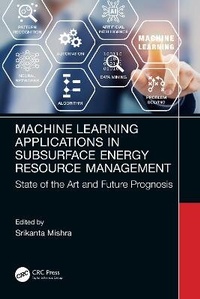
Machine Learning Applications in Subsurface Energy Resource Management
State of the Art and Future Prognosis
1st Edition
Published on 30. June 2024
Book
Paperback/Softback
384 pages
978-1-032-07455-9 (ISBN)
Description
The utilization of machine learning (ML) techniques to understand hidden patterns and build data-driven predictive models from complex multivariate datasets is rapidly increasing in many applied science and engineering disciplines, including geo-energy. Motivated by these developments, Machine Learning Applications in Subsurface Energy Resource Management presents a current snapshot of the state of the art and future outlook for ML applications to manage subsurface energy resources (e.g., oil and gas, geologic carbon sequestration, and geothermal energy).
* Covers ML applications across multiple application domains (reservoir characterization, drilling, production, reservoir modeling, and predictive maintenance).
* Offers a variety of perspectives from authors representing operating companies, universities, and research organizations.
* Provides an array of case studies illustrating the latest applications of several ML techniques.
* Includes a literature review and future outlook for each application domain.
This book is targeted at the practicing petroleum engineer or geoscientist interested in developing a broad understanding of ML applications across several subsurface domains. It is also aimed as a supplementary reading for graduate-level courses and will also appeal to professionals and researchers working with hydrogeology and nuclear waste disposal.
* Covers ML applications across multiple application domains (reservoir characterization, drilling, production, reservoir modeling, and predictive maintenance).
* Offers a variety of perspectives from authors representing operating companies, universities, and research organizations.
* Provides an array of case studies illustrating the latest applications of several ML techniques.
* Includes a literature review and future outlook for each application domain.
This book is targeted at the practicing petroleum engineer or geoscientist interested in developing a broad understanding of ML applications across several subsurface domains. It is also aimed as a supplementary reading for graduate-level courses and will also appeal to professionals and researchers working with hydrogeology and nuclear waste disposal.
More details
Language
English
Place of publication
London
United Kingdom
Publishing group
Taylor & Francis Ltd
Target group
Professional and scholarly
Academic and Professional Practice & Development
Illustrations
169 s/w Abbildungen, 69 s/w Photographien bzw. Rasterbilder, 100 s/w Zeichnungen, 29 s/w Tabellen
29 Tables, black and white; 100 Line drawings, black and white; 69 Halftones, black and white; 169 Illustrations, black and white
Dimensions
Height: 229 mm
Width: 152 mm
ISBN-13
978-1-032-07455-9 (9781032074559)
Copyright in bibliographic data and cover images is held by Nielsen Book Services Limited or by the publishers or by their respective licensors: all rights reserved.
Schweitzer Classification
Other editions
Additional editions
Srikanta Mishra
Machine Learning Applications in Subsurface Energy Resource Management
State of the Art and Future Prognosis
Book
12/2022
1st Edition
CRC Press
€178.27
Shipment within 10-20 days
Srikanta Mishra
Machine Learning Applications in Subsurface Energy Resource Management
State of the Art and Future Prognosis
E-Book
12/2022
1st Edition
CRC Press
€138.99
Available for download
Srikanta Mishra
Machine Learning Applications in Subsurface Energy Resource Management
State of the Art and Future Prognosis
E-Book
12/2022
1st Edition
CRC Press
€138.99
Available for download
Person
Dr. Srikanta Mishra is Senior Research Leader and Technical Director for Geo-energy Resource Modeling and Analytics at Battelle Memorial Institute, the world's largest independent contract R&D organization. He is nationally and internationally recognized for his expertise in developing and communicating physics-based and data-driven predictive models for subsurface resource management. Dr. Mishra currently serves as the Technical Lead of the SMART (Science Informed Machine Learning for Accelerating Real-time Decisions for Subsurface applications) initiative, organized by the US Department of Energy and involving multiple national laboratories and universities. He was a recipient of the Society of Petroleum Engineers (SPE) Distinguished Member Award in 2021, and also served as a Global Distinguished Lecturer on Big Data Analytics for SPE during 2018-19 and received the 2022 SPE Data Science and Engineering Analytics Award.
Content
Part 1: Reservoir Characterization 1. Machine Learning in Geophysical Imaging Modalities for Unconventional Plays 2. Machine Learning for Discovering, Understanding and Extracting Geothermal Energy (Velimir Vesselinov, Los Alamos National Laboratory) 3. Enhancing Our Understanding of the Subsurface With Ml/ai Applied to Well and Seismic Data Part 2: Drilling Operations 4. Overview of Ml/ai Applications in Drilling 5. Using Machine Learning to Improve Drilling Operations in Unconventional and Tight Rocks Part 3: Production Data Analysis 6. Application of Physics-informed Neural Networks in the Analysis of Production Data From Unconventional Reservoirs 7. Machine Learning Assisted Decline Curve and Pressure/rate Transient Analysis in Unconventional Plays (Dmachine Learning Case Studies for Performance Forecasting of Oil and Gas Reservoirs 8. Role of Analytics in Extracting Data-driven Models From Reservoir Surveillance Part 4: Reservoir Modeling 9. Deep-learning and Reduced-order Model Based Proxies for History Matching and Uncertainty Quantification 10. Hybrid Machine Learning and Physics-informed Reservoir Modeling for Unconventionals 11. New Machine Learning and Deep Learning Approaches for Field Development and Production Optimization 12. Physics-embedded Machine Learning for Modeling and Optimization of Oil and Gas Assets 13. Reservoir Modeling Using Fast Predictive Machine Learning Algorithms for Geological Carbon Storage 14. Top-down Reservoir Modeling