

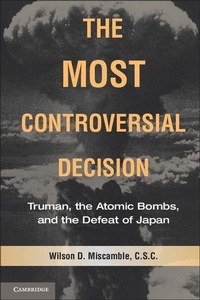
The Most Controversial Decision
Truman, the Atomic Bombs, and the Defeat of Japan
Published on 11. April 2011
Book
Paperback/Softback
192 pages
978-0-521-73536-0 (ISBN)
Description
This book explores the American use of atomic bombs and the role these weapons played in the defeat of the Japanese Empire in World War II. It focuses on President Harry S. Truman's decision-making regarding this most controversial of all his decisions. The book relies on notable archival research and the best and most recent scholarship on the subject to fashion an incisive overview that is fair and forceful in its judgments. This study addresses a subject that has been much debated among historians and it confronts head-on the highly disputed claim that the Truman administration practised 'atomic diplomacy'. The book goes beyond its central historical analysis to ask whether it was morally right for the United States to use these terrible weapons against Hiroshima and Nagasaki. It also provides a balanced evaluation of the relationship between atomic weapons and the origins of the Cold War.
Reviews / Votes
'Drawing on the many scholarly works that discuss the reasons why President Harry S. Truman and his closest advisers considered that the use of the atomic bomb against Japan in August 1945 was a necessary measure, the circumstances that surrounded the Japanese decision to surrender, and the role that possession of the atomic bomb may have played in American diplomacy towards the Soviet Union, Wilson Miscamble has also utilised his own formidable knowledge of the primary sources to produce a wonderfully compressed and trenchantly argued book.' International AffairsMore details
Series
Language
English
Place of publication
Cambridge
United Kingdom
Target group
College/higher education
Professional and scholarly
Product notice
Paperback (trade)
Illustrations
1 Maps; 17 Halftones, unspecified
Dimensions
Height: 229 mm
Width: 152 mm
Thickness: 10 mm
Weight
284 gr
ISBN-13
978-0-521-73536-0 (9780521735360)
Copyright in bibliographic data and cover images is held by Nielsen Book Services Limited or by the publishers or by their respective licensors: all rights reserved.
Schweitzer Classification
Person
The Reverend Wilson D. Miscamble, C.S.C., joined the permanent faculty at Notre Dame in 1988. A native of Australia, he was educated at the University of Queensland, from which he graduated in 1973 and obtained a master's degree three years later. In 1976, he came to Notre Dame to pursue graduate studies in history. He received his doctoral degree in 1980. He then served for two years as North American analyst in the Office of National Assessments, Department of Prime Minister and Cabinet, Canberra, Australia. In August 1982, he returned to Notre Dame and entered the priestly formation program of the Congregation of Holy Cross. He was ordained a priest on April 9, 1988. His primary research interest is American foreign policy since World War II. He is the author of George F. Kennan and the Making of American Foreign Policy, 1947-1950 and Keeping the Faith, Making a Difference. He has edited American Political History: Essays on the State of the Discipline and Go Forth and Do Good: Memorable Notre Dame Commencement Addresses. His most recent book, From Roosevelt to Truman: Potsdam, Hiroshima, and the Cold War, was published in 2007 and received the Harry S. Truman Book Award in 2008.
Content
1. Introduction: the most controversial decision; 2. Franklin Roosevelt, the Manhattan project, and the development of the atomic bomb; 3. Harry Truman, Henry Stimson, and atomic briefings; 4. James F. Byrnes, the atomic bomb, and the Pacific war; 5. The Potsdam conference, the trinity test, and 'atomic diplomacy'; 6. Hiroshima, the Japanese, and the Soviets; 7. The Japanese surrender; 8. Necessary, but was it right?; 9. Byrnes, the Soviets, and the American atomic monopoly; 10. The atomic bomb and the origins of the Cold War.