

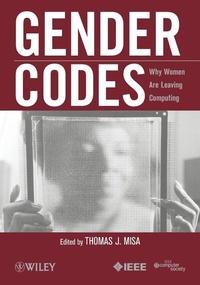
Gender Codes
Why Women Are Leaving Computing
1st Edition
Published on 20. August 2010
Book
Paperback/Softback
328 pages
978-0-470-59719-4 (ISBN)
Description
The computing profession faces a serious gender crisis. Today, fewer women enter computing than anytime in the past 25 years. This book provides an unprecedented look at the history of women and men in computing, detailing how the computing profession emerged and matured, and how the field became male coded. Women's experiences working in offices, education, libraries, programming, and government are examined for clues on how and where women succeeded-and where they struggled. It also provides a unique international dimension with studies examining the U.S., Great Britain, Germany, Norway, and Greece. Scholars in history, gender/women's studies, and science and technology studies, as well as department chairs and hiring directors will find this volume illuminating.
Reviews / Votes
"This is a very valuable book in dispelling many of the myths about women and computing . . . For anyone interested in understanding why women are not attracted to the computing profession, including teachers and IT managers, this book is highly recommended. It provides an in-depth understanding of how and whywe are where we are." (Sex Roles, 2011) "Gender Codes is an important book . . . this is a task in which the IEEE History Center can play a role, and we think our readers can and should as well-they can begin with reading this seminal book" (Bibliography, 1 March 2011)
"This book is an excellent introduction to some of the main themes, and there are many more chapters waiting to be written." (IEEE Annals of the History of Computing, 1 April 2011)
"Summing up: Recommended [for] all levels/libraries." (CHOICE, January 2011)
More details
Language
English
Place of publication
New York
United States
Target group
Professional and scholarly
Product notice
Paperback (trade)
Unsewn / adhesive bound
Illustrations
Charts: 16 B&W, 0 Color; Photos: 53 B&W, 0 Color; Drawings: 0 B&W, 0 Color
Dimensions
Height: 254 mm
Width: 178 mm
Thickness: 18 mm
Weight
616 gr
ISBN-13
978-0-470-59719-4 (9780470597194)
Copyright in bibliographic data and cover images is held by Nielsen Book Services Limited or by the publishers or by their respective licensors: all rights reserved.
Schweitzer Classification
Other editions
Additional editions
E-Book
09/2011
Wiley-IEEE Computer Society Press
€34.99
Available for download
E-Book
06/2010
Wiley
€33.99
Available for download
Person
THOMAS J. MISA is at the University of Minnesota, where he directs the Charles Babbage Institute, teaches in the graduate program for the History of Science, Technology, and Medicine, and is a faculty member in the Department of Electrical and Computer Engineering.
Content
Foreword ix
Preface xiii
Contributors xv
PART I: TOOLS FOR UNDERSTANDING 1
1 Gender Codes 3
Defining the Problem
Thomas J. Misa
2 Computer Science 25
The Incredible Shrinking Woman
Caroline Clarke Hayes
3 Masculinity and the Machine Man 51
Gender in the History of Data Processing
Thomas Haigh
PART II: INSTITUTIONAL LIFE 73
4 A Gendered Job Carousel 75
Employment Effects of Computer Automation
Corinna Schlombs
5 Meritocracy and Feminization in Confl ict 95
Computerization in the British Government
Marie Hicks
6 Making Programming Masculine 115
Nathan Ensmenger
7 Gender and Computing in the Push-Button Library 143
Greg Downey
PART III: MEDIA AND CULTURE 163
8 Cultural Perceptions of Computers in Norway 1980-2007 165
From "Anybody" Via "Male Experts" to "Everybody"
Hilde G. Corneliussen
9 Constructing Gender and Technology in Advertising Images 187
Feminine and Masculine Computer Parts
Aristotle Tympas, Hara Konsta, Theodore Lekkas, and Serkan Karas
PART IV: WOMEN IN COMPUTING 211
10 The Pleasure Paradox 213
Bridging the Gap Between Popular Images of Computing and Women's Historical Experiences
Janet Abbate
11 Programming Enterprise 229
Women Entrepreneurs in Software and Computer Services
Jeffrey R. Yost
12 Gender Codes 251
Lessons from History
Thomas J. Misa
13 Gender Codes 265
Prospects for Change
Caroline Clarke Hayes
Bibliography 275
Index 297
Preface xiii
Contributors xv
PART I: TOOLS FOR UNDERSTANDING 1
1 Gender Codes 3
Defining the Problem
Thomas J. Misa
2 Computer Science 25
The Incredible Shrinking Woman
Caroline Clarke Hayes
3 Masculinity and the Machine Man 51
Gender in the History of Data Processing
Thomas Haigh
PART II: INSTITUTIONAL LIFE 73
4 A Gendered Job Carousel 75
Employment Effects of Computer Automation
Corinna Schlombs
5 Meritocracy and Feminization in Confl ict 95
Computerization in the British Government
Marie Hicks
6 Making Programming Masculine 115
Nathan Ensmenger
7 Gender and Computing in the Push-Button Library 143
Greg Downey
PART III: MEDIA AND CULTURE 163
8 Cultural Perceptions of Computers in Norway 1980-2007 165
From "Anybody" Via "Male Experts" to "Everybody"
Hilde G. Corneliussen
9 Constructing Gender and Technology in Advertising Images 187
Feminine and Masculine Computer Parts
Aristotle Tympas, Hara Konsta, Theodore Lekkas, and Serkan Karas
PART IV: WOMEN IN COMPUTING 211
10 The Pleasure Paradox 213
Bridging the Gap Between Popular Images of Computing and Women's Historical Experiences
Janet Abbate
11 Programming Enterprise 229
Women Entrepreneurs in Software and Computer Services
Jeffrey R. Yost
12 Gender Codes 251
Lessons from History
Thomas J. Misa
13 Gender Codes 265
Prospects for Change
Caroline Clarke Hayes
Bibliography 275
Index 297