

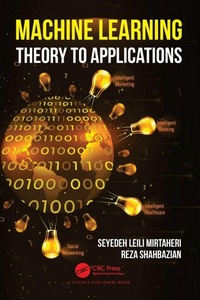
Machine Learning
Theory to Applications
1st Edition
Published on 29. September 2022
Book
Paperback/Softback
202 pages
978-0-367-63456-8 (ISBN)
Description
The book reviews core concepts of machine learning (ML) while focusing on modern applications. It is aimed at those who want to advance their understanding of ML by providing technical and practical insights. It does not use complicated mathematics to explain how to benefit from ML algorithms. Unlike the existing literature, this work provides the core concepts with emphasis on fresh ideas and real application scenarios. It starts with the basic concepts of ML and extends the concepts to the different deep learning algorithms. The book provides an introduction and main elements of evaluation tools with Python and walks you through the recent applications of ML in self-driving cars, cognitive decision making, communication networks, security, and signal processing. The concept of generative networks is also presented and focuses on GANs as a tool to improve the performance of existing algorithms.
In summary, this book provides a comprehensive technological path from fundamental theories to the categorization of existing algorithms, covers state-of-the-art, practical evaluation tools and methods to empower you to use synthetic data to improve the performance of applications.
In summary, this book provides a comprehensive technological path from fundamental theories to the categorization of existing algorithms, covers state-of-the-art, practical evaluation tools and methods to empower you to use synthetic data to improve the performance of applications.
More details
Language
English
Place of publication
London
United Kingdom
Publishing group
Taylor & Francis Ltd
Target group
Professional and scholarly
Academic
Illustrations
7 farbige Zeichnungen, 15 s/w Abbildungen, 7 farbige Abbildungen, 8 s/w Photographien bzw. Rasterbilder, 7 s/w Zeichnungen
7 Line drawings, color; 7 Line drawings, black and white; 8 Halftones, black and white; 7 Illustrations, color; 15 Illustrations, black and white
Dimensions
Height: 234 mm
Width: 156 mm
Thickness: 12 mm
Weight
330 gr
ISBN-13
978-0-367-63456-8 (9780367634568)
Copyright in bibliographic data and cover images is held by Nielsen Book Services Limited or by the publishers or by their respective licensors: all rights reserved.
Schweitzer Classification
Other editions
Additional editions
E-Book
09/2022
1st Edition
CRC Press
€78.99
Available for download
E-Book
09/2022
1st Edition
CRC Press
€78.99
Available for download
Book
09/2022
1st Edition
CRC Press
€247.20
Shipment within 15-20 days
Persons
Seyedeh Leili Mirtaheri is an assistant professor in the Electrical and Computer Engineering Department at Kharazmi University. She holds PhD degrees in computer engineering and also in operations research. She has authored several journal articles and conference proceedings and has also been an author/editor of several books. She has been a guest editor of the Journal of Supercomputing and also the reviewer of many credible journals.
Reza Shahbazian is an assistant professor of Standard Research Institute (Iran) and researcher at Unical. He holds PhD degrees in telecommunications and computer science. He has served as a postdoc researcher on applications of machine learning in telecommunication networks. He has authored several articles in journals and conference proceedings, book chapters and also authored or edited five books.
Reza Shahbazian is an assistant professor of Standard Research Institute (Iran) and researcher at Unical. He holds PhD degrees in telecommunications and computer science. He has served as a postdoc researcher on applications of machine learning in telecommunication networks. He has authored several articles in journals and conference proceedings, book chapters and also authored or edited five books.
Content
1. Introduction 2. Linear Algebra 3. Machine Learning 4. Some Practical Notes 5. Deep Learning 6. Generative Adversarial Networks 7. Implementation