

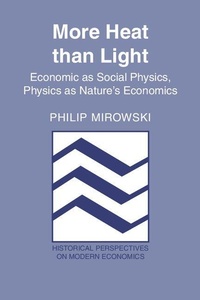
More Heat than Light
Economics as Social Physics, Physics as Nature's Economics
Published on 29. November 1991
Book
Paperback/Softback
464 pages
978-0-521-42689-3 (ISBN)
Description
More Heat Than Light is a history of how physics has drawn some inspiration from economics and also how economics has sought to emulate physics, especially with regard to the theory of value. It traces the development of the energy concept in Western physics and its subsequent effect upon the invention and promulgation of neoclassical economics. Any discussion of the standing of economics as a science must include the historical symbiosis between the two disciplines. Starting with the philosopher Emile Meyerson's discussion of the relationship between notions of invariance and causality in the history of science, the book surveys the history of conservation principles in the Western discussion of motion. Recourse to the metaphors of the economy are frequent in physics, and the concepts of value, motion, and body reinforced each other throughout the development of both disciplines, especially with regard to practices of mathematical formalisation. However, in economics subsequent misuse of conservation principles led to serious blunders in the mathematical formalisation of economic theory. The book attempts to provide the reader with sufficient background in the history of physics in order to appreciate its theses. The discussion is technically detailed and complex, and familiarity with calculus is required.
Reviews / Votes
"Intellectual stars of his magnitude (as opposed to scientific stars) don't come along very often....in More Heat Than Light...he states a challenge that is going to haunt economists for years....Mirowski and his ideas are about to move out of the history of economics into the wider stream." David Warsh, The Boston Globe "...a major contribution to twentieth century literature in economic thought. It is destined to become a classic and must be read and reread." Southern Economic Journal "...an excellent and enthralling volume, written with great erudition and wit." Review of Political Economy "No previous writer has made such a sustained and determined effort to explore the undeniably important conceptual links between economics and physics; and this alone is a landmark contribution of importance to all economists, not merely to specialist historians of the discipline." Kyklos "...an example of the history of economic theory at its best." Charles M. A. Clark, Eastern Economic JournalMore details
Series
Language
English
Place of publication
Cambridge
United Kingdom
Target group
Professional and scholarly
Product notice
Paperback (trade)
Illustrations
Worked examples or Exercises
Dimensions
Height: 229 mm
Width: 152 mm
Thickness: 28 mm
Weight
748 gr
ISBN-13
978-0-521-42689-3 (9780521426893)
Copyright in bibliographic data and cover images is held by Nielsen Book Services Limited or by the publishers or by their respective licensors: all rights reserved.
Schweitzer Classification
Other editions
Additional editions
E-Book
05/2012
1st Edition
Cambridge University Press
€44.49
Available for download
E-Book
11/1991
Cambridge University Press
€37.99
Available for download

Book
11/1989
Cambridge University Press
€74.34
Article exhausted; check for reprint
Previous edition
Book
11/1989
Cambridge University Press
€74.34
Article exhausted; check for reprint
Person
Content
List of figures; List of tables; Epigraph; Acknowledgments; Dedication; 1. The fearful spheres of Pascal and Parmenides; 2. Everything an economist needs to know about physics but was probably afraid to ask: the history of the energy concept; 3. Body, motions and value; 4. Science and substance theories of value in political economy to 1870; 5. Neoclassical economics: an irresistible field of force meets an immovable object; 6. The corruption of the field theory of value, and the retrogression to substance theories of value: neoclassical production theory; 7. The ironies of physics envy; 8. Universal history is the story of different intonations given to a handful of metaphors.