

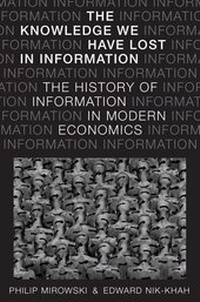
The Knowledge We Have Lost in Information
The History of Information in Modern Economics
Published on 3. August 2017
Book
Hardback
312 pages
978-0-19-027005-6 (ISBN)
Description
Information is a central concept in economics, and The Knowledge We Have Lost in Information explores its treatment in modern economics. The study of information, far from offering enlightenment, resulted in all matter of confusion for economists and the public.
Philip Mirowski and Edward Nik-Khah argue that the conventional wisdom suggesting "economic rationality" was the core of modern economics is incomplete. In this trenchant investigation, they demonstrate that the history of modern microeconomics is better organized as a history of the treatment of information. The book begins with a brief primer on information, and then shows how economists have responded over time to successive developments on the concept of information in the natural sciences. Mirowski and Nik-Khah detail various intellectual battles that were fought to define, analyze, and employ information in economics. As these debates developed, economists progressively moved away from pure agent conscious self-awareness as a non-negotiable desideratum of economic models toward a focus on markets and their design as information processors. This has led to a number of policies, foremost among them: auction design of resources like the electromagnetic spectrum crucial to modern communications.
The Knowledge We Have Lost in Information provides insight into the interface between disputes within the economics discipline and the increasing role of information in contemporary society. Mirowski and Nik-Shah examine how this intersection contributed to the dominance of neoliberal approaches to economics, politics, and other realms.
Philip Mirowski and Edward Nik-Khah argue that the conventional wisdom suggesting "economic rationality" was the core of modern economics is incomplete. In this trenchant investigation, they demonstrate that the history of modern microeconomics is better organized as a history of the treatment of information. The book begins with a brief primer on information, and then shows how economists have responded over time to successive developments on the concept of information in the natural sciences. Mirowski and Nik-Khah detail various intellectual battles that were fought to define, analyze, and employ information in economics. As these debates developed, economists progressively moved away from pure agent conscious self-awareness as a non-negotiable desideratum of economic models toward a focus on markets and their design as information processors. This has led to a number of policies, foremost among them: auction design of resources like the electromagnetic spectrum crucial to modern communications.
The Knowledge We Have Lost in Information provides insight into the interface between disputes within the economics discipline and the increasing role of information in contemporary society. Mirowski and Nik-Shah examine how this intersection contributed to the dominance of neoliberal approaches to economics, politics, and other realms.
Reviews / Votes
"Mirowski and Nik-Khah ask questions of current economics and its direction that no one else is asking. What is information for economists, and does its production and transformation in markets bear any relation to Truth and Knowledge? Does an economics of information have any need for economic 'agents'? Do people only get in the way when economists design markets? If the market is the only source of Truth, what is the role of the economist? This book ishighly recommended for all hoping to make sense of economics today. "
-- John B. Davis, Marquette University and University of Amsterdam
"The Knowledge We Lost in Information reveals how many concepts familiar to the average microeconomist have surprising intellectual roots. It tells the fascinating history of how the concept of information made its way into economics, emphasizing the way Friedrich Hayek used it to argue against the feasibility of socialism. The book will help self-reflective economists understand the history and implicit connotations of ideas that are too often taken
for granted."
-- Thomas Vass, Manager of The Young Scholars Initiative, Institute for New Economic Thinking
"Mirowski's and Nik-Khah's book provides an entirely new reconstruction of the intellectual history of Post-World War II economics centered on the construction of the notion of information. The Knowledge We Have Lost in Information is an innovative and inspiring essay, built as a modern spy novel."
-- Annie L. Cot, University Paris 1 Pantheon-Sorbonne
"A blazing jeremiad, a cage-shaking roar, a flaming bolt across the bow of market design and the confused, often self-serving notions of "information" on which it is based. Mirowski and Nik-Khah have written an Emperor's New Clothes for post-World War II economics, exhuming deep history to expose incoherencies and shatter the mirror-hall of "agents" who know nothing, everything, or something -- somehow all at once."
-- Paul N. Edwards, Paul N. Edwards, Professor of Information and History, University of Michigan
More details
Language
English
Place of publication
New York
United States
Target group
College/higher education
Dimensions
Height: 150 mm
Width: 216 mm
Thickness: 25 mm
Weight
408 gr
ISBN-13
978-0-19-027005-6 (9780190270056)
Copyright in bibliographic data and cover images is held by Nielsen Book Services Limited or by the publishers or by their respective licensors: all rights reserved.
Schweitzer Classification
Other editions
Additional editions
Philip Mirowski | Edward Nik-Khah
The Knowledge We Have Lost in Information
The History of Information in Modern Economics
E-Book
06/2017
1st Edition
OUP eBook
€33.99
Available for download
Philip Mirowski | Edward Nik-Khah
The Knowledge We Have Lost in Information
The History of Information in Modern Economics
E-Book
06/2017
1st Edition
OUP eBook
€33.99
Available for download
Persons
PM: Carl Koch Professor of Economics and the History and Philosophy of Science, University of Notre Dame, INEN-K: Associate Professor of Economics, Roanoke College, VA
Content
Contents
List of Tables and Figures Chapter 1 It's Not Rational
Chapter 2 The Standard Narrative and the Bigger Picture
Chapter 3 Natural Science Inspirations
Chapter 4 The Nobels and the Neoliberals
Chapter 5 The Socialist Calculation Controversy as the Starting Point of the Economics of Information
Chapter 6 Hayek Changes his Mind
Chapter 7 The Neoclassical Economics of Information was incubated at Cowles
Chapter 8 Three Different Modalities of Information in Neoclassical Theory
Chapter 9 Going the Market One Better
Chapter 10 The History of Markets and the Theory of Market Design
Chapter 11 The Walrasian School of Design
Chapter 12 The Bayes-Nash School of Design
Chapter 13 The Experimentalist School of Design
Chapter 14 Hayek and the Schools of Design
Chapter 15 Designs on the Market: The FCC Spectrum Auctions
Chapter 16 Private Intellectuals and Public Perplexity: The TARP
Chapter 17 Artificial Ignorance
List of Tables and Figures Chapter 1 It's Not Rational
Chapter 2 The Standard Narrative and the Bigger Picture
Chapter 3 Natural Science Inspirations
Chapter 4 The Nobels and the Neoliberals
Chapter 5 The Socialist Calculation Controversy as the Starting Point of the Economics of Information
Chapter 6 Hayek Changes his Mind
Chapter 7 The Neoclassical Economics of Information was incubated at Cowles
Chapter 8 Three Different Modalities of Information in Neoclassical Theory
Chapter 9 Going the Market One Better
Chapter 10 The History of Markets and the Theory of Market Design
Chapter 11 The Walrasian School of Design
Chapter 12 The Bayes-Nash School of Design
Chapter 13 The Experimentalist School of Design
Chapter 14 Hayek and the Schools of Design
Chapter 15 Designs on the Market: The FCC Spectrum Auctions
Chapter 16 Private Intellectuals and Public Perplexity: The TARP
Chapter 17 Artificial Ignorance