

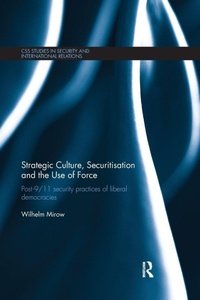
Strategic Culture, Securitisation and the Use of Force
Post-9/11 Security Practices of Liberal Democracies
1st Edition
Published on 30. June 2020
Book
Paperback/Softback
250 pages
978-0-367-59682-8 (ISBN)
Description
This book investigates, and explains, the extent to which different liberal democracies have resorted to the use of force since the 9/11 terrorist attacks.
The responses of democratic states throughout the world to the September 2001 terrorist attacks have varied greatly. This book analyses the various factors that had an impact on decisions on the use of force by governments of liberal democratic states. It seeks to explain differences in the security policies and practices of Australia, Canada, France, Germany and the UK regarding the war in Afghanistan, domestic counterterrorism measures and the Iraq War. To this end, the book combines the concepts of strategic culture and securitisation into a theoretical model that disentangles the individual structural and agential causes of the use of force by the state and sequentially analyses the impact of each causal component on the other. It argues that the norms of a strategic culture shape securitisation processes of different expressions, which then bring about distinct modes of the use of force in individual security policy decisions. While governments can also deviate from the constraints of a strategic culture, this is likely to encounter a strong reaction from large parts of the population which in turn can lead to a long-term change in strategic culture.
This book will be of much interest to students of strategic culture, securitisation, European politics, security studies and IR in general.
The responses of democratic states throughout the world to the September 2001 terrorist attacks have varied greatly. This book analyses the various factors that had an impact on decisions on the use of force by governments of liberal democratic states. It seeks to explain differences in the security policies and practices of Australia, Canada, France, Germany and the UK regarding the war in Afghanistan, domestic counterterrorism measures and the Iraq War. To this end, the book combines the concepts of strategic culture and securitisation into a theoretical model that disentangles the individual structural and agential causes of the use of force by the state and sequentially analyses the impact of each causal component on the other. It argues that the norms of a strategic culture shape securitisation processes of different expressions, which then bring about distinct modes of the use of force in individual security policy decisions. While governments can also deviate from the constraints of a strategic culture, this is likely to encounter a strong reaction from large parts of the population which in turn can lead to a long-term change in strategic culture.
This book will be of much interest to students of strategic culture, securitisation, European politics, security studies and IR in general.
More details
Series
Language
English
Place of publication
London
United Kingdom
Publishing group
Taylor & Francis Ltd
Target group
College/higher education
Professional and scholarly
Postgraduate, Professional, and Undergraduate
Dimensions
Height: 234 mm
Width: 156 mm
Weight
500 gr
ISBN-13
978-0-367-59682-8 (9780367596828)
Copyright in bibliographic data and cover images is held by Nielsen Book Services Limited or by the publishers or by their respective licensors: all rights reserved.
Schweitzer Classification
Other editions
Additional editions
Wilhelm Mirow
Strategic Culture, Securitisation and the Use of Force
Post-9/11 Security Practices of Liberal Democracies
Book
04/2016
1st Edition
Routledge
€242.00
Shipment within 10-20 days
Wilhelm Mirow
Strategic Culture, Securitisation and the Use of Force
Post-9/11 Security Practices of Liberal Democracies
E-Book
04/2016
Routledge
€59.49
Available for download
Wilhelm Mirow
Strategic Culture, Securitisation and the Use of Force
Post-9/11 Security Practices of Liberal Democracies
E-Book
04/2016
Routledge
€59.49
Available for download
Person
Wilhlem Mirow has a PhD in International Relations, Center for Security Studies (CSS), Swiss Federal Institute of Technology (ETH) Zurich.
Content
Introduction PART I: A COMPREHENSIVE MODEL OF THE USE OF FORCE BY THE STATE 1. Ontology and causation in International Relations 2. The theoretical model incorporating strategic culture and securitisation 3. Operationalising the Theoretical Model PART II: COMPARING STRATEGIC CULTURES 4. Formative Moments, Founding Narratives and Identity Conceptions 5. Comparative Cross-country Analysis PART III: COMPARING DECISION PROCESSES ON THE USE OF FORCE 6. Analysing British Decision Processes on the Use of Force 7. Analysing German Decision processes on the Use of Force 8. Analysing French Decisions on the Use of Force 9. Analysing Australian Decisions on the Use of Force 10. Analysing Canadian Decisions on the Use of Force Conclusion