

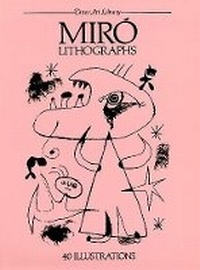
Miro Lithographs
Published on 28. March 2003
Book
Paperback/Softback
48 pages
978-0-486-24437-2 (ISBN)
Description
"As regards my means of expression, I try my hardest to achieve the maximum of clarity, power, and plastic aggressiveness; a physical sensation to begin with, followed up by an impact on the psyche." - Miro
Miro's line recalls Picasso's in clarity and power; the Catalan's "plastic aggressiveness" led him, as it did his Andalusian friend, to bold, successful experiment and innovation in ceramics, sculpture and printmaking, especially lithography. The lithographic print medium suited and encouraged the artist's lifelong, often radical, obsession with stripping art to the marrow. The 40 plates reproduced here sample the pith of his lithographic production - a series produced in 1944, full of the eerie images and droll distortion he had sought on canvas for decades.
"It's never easy for me to talk about my painting," wrote Miro, "since it is always born in a state of hallucination induced by some kind of shock, objective or subjective, for which I am not personally responsible in the least." Miro hallucinates on stone for these prints, filling them with monstrous beasts and one-eyed aliens adrift in a heaven of moons and stars and black nebulae, floating breasts and generative organs. These lithographs were executed shortly after finishing the famous "constellation" series of paintings (called by one critic "the most intricate, most elaborately developed of all Miro's compositions"), right around the time his mother died and he fired his first ceramics in collaboration with Artigas.
Falling in a period of intense creative mingling of whimsy with the grotesque, these prints characterize an important juncture in Miro's career. They also enlarge the boundaries of lithographic technique as they simultaneously show Miro, now "stripped" of his brilliant colors, to be an equal master of black-and-white.
Miro's line recalls Picasso's in clarity and power; the Catalan's "plastic aggressiveness" led him, as it did his Andalusian friend, to bold, successful experiment and innovation in ceramics, sculpture and printmaking, especially lithography. The lithographic print medium suited and encouraged the artist's lifelong, often radical, obsession with stripping art to the marrow. The 40 plates reproduced here sample the pith of his lithographic production - a series produced in 1944, full of the eerie images and droll distortion he had sought on canvas for decades.
"It's never easy for me to talk about my painting," wrote Miro, "since it is always born in a state of hallucination induced by some kind of shock, objective or subjective, for which I am not personally responsible in the least." Miro hallucinates on stone for these prints, filling them with monstrous beasts and one-eyed aliens adrift in a heaven of moons and stars and black nebulae, floating breasts and generative organs. These lithographs were executed shortly after finishing the famous "constellation" series of paintings (called by one critic "the most intricate, most elaborately developed of all Miro's compositions"), right around the time his mother died and he fired his first ceramics in collaboration with Artigas.
Falling in a period of intense creative mingling of whimsy with the grotesque, these prints characterize an important juncture in Miro's career. They also enlarge the boundaries of lithographic technique as they simultaneously show Miro, now "stripped" of his brilliant colors, to be an equal master of black-and-white.
More details
Series
Language
English
Place of publication
United States
Dimensions
Height: 278 mm
Width: 210 mm
Thickness: 4 mm
Weight
180 gr
ISBN-13
978-0-486-24437-2 (9780486244372)
Copyright in bibliographic data and cover images is held by Nielsen Book Services Limited or by the publishers or by their respective licensors: all rights reserved.
Schweitzer Classification