

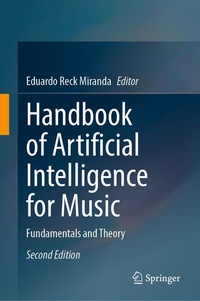
Handbook of Artificial Intelligence for Music
Description
AI technology permeates the music industry, from management systems for recording studios to recommendation systems for online commercialization of music through the Internet. Yet whereas AI for online music distribution is well advanced, this unique handbook focuses on a largely unexplored application: AI for creating the actual musical content.
Significantly, the two-volume reference presents comprehensive coverage of the latest advances in research into enabling machines to listen to and compose new music.
The first volume, Fundamentals and Theory, essentially covers basic research, theoretical approaches and applications of AI in signal processing. The second volume, Approaches and Practices, focuses on applications of AI in musical composition, performance and robotics. Emerging new approaches to AI-based musical creativity also are introduced, including brain-computer music interfaces, bio-processors and quantum computing.
Topics and features:
* Presents the definitive work on AI and music computing, featuring insights from leading experts and practitioners in the field
* Highlights how AI is much more than just deep learning, showcasing a range of different approaches and developments
* Introduces new and emerging topics in AI, including biocomputing and quantum computing
Prof. Eduardo Reck Miranda is a composer and professor in Computer Music at the University of Plymouth, UK, where he is director of the Interdisciplinary Centre for Computer Music Research. His previous publications include the Springer titles Guide to Unconventional Computing for Music, Guide to Brain-Computer Music Interfacing and Guide to Computing for Expressive Music Performance.
More details
Other editions
Previous edition
Person
Content
.- Sociocultural and Design Perspectives on AI-Based Music Production:Why Do We Make Music and What Changes if AI Makes It for Us?.
.- Human-Machine Simultaneity in the Compositional Process.
.- Artificial Intelligence for Music Composition.
.- Cognitive Musicology and Artificial Intelligence: Harmonic Analysis, Learning, and Generation.
.- On Modelling Harmony with Constraint Programming for Algorithmic Composition, Including a Model of Schoenberg's Theory of Harmony.
.- Constraint-Solving Systems in Music Creation.
.- AI Music Mixing Systems.
.- Machine Improvisation in Music: Information-Theoretical Approach.
.- Structure, Abstraction and Reference in Artificial Musical IntelligenceStructure, Abstraction and Reference in Artificial Musical Intelligence.
.- Folk the Algorithms: (Mis)Applying Artificial Intelligence to Folk Music.
.- Assisted Music Creation with Flow Machines: Towards New Categories of New.
.- Imitative Computer-Aided Musical Orchestration with Biologically Inspired Algorithms.
.- Human-Centred Artificial Intelligence in Concatenative Sound Synthesis.
.- Deep Generative Models for Musical Audio Synthesis.
.- Transfer Learning for Generalized Audio Signal Processing.
.- From Audio to Music Notation.
.- Automatic Transcription of Polyphonic Vocal Music.
.- Graph-Based Representation, Analysis, and Interpretation of Popular Music Lyrics Using Semantic Embedding Features.
.- Musicking with Algorithms: Thoughts on Artificial Intelligence, Creativity, and Agency.