

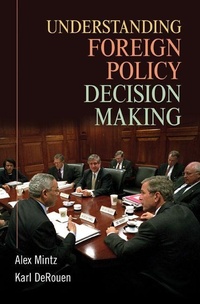
Understanding Foreign Policy Decision Making
Published on 8. March 2010
Book
Hardback
224 pages
978-0-521-87645-2 (ISBN)
Description
Understanding Foreign Policy Decision Making presents a psychological approach to foreign policy decision making. This approach focuses on the decision process, dynamics, and outcome. The book includes a wealth of extended real-world case studies and examples that are woven into the text. The cases and examples, which are written in an accessible style, include decisions made by leaders of the United States, Israel, New Zealand, Cuba, Iceland, United Kingdom, and others. In addition to coverage of the rational model of decision making, levels of analysis of foreign policy decision making, and types of decisions, the book includes extensive material on alternatives to the rational choice model, the marketing and framing of decisions, cognitive biases, and domestic, cultural, and international influences on decision making in international affairs. Existing textbooks do not present such an approach to foreign policy decision making, international relations, American foreign policy, and comparative foreign policy.
Reviews / Votes
'... Understanding Foreign Policy Decision Making ... is a tour d'horizon of foreign policy-making analysis that offers valuable insights into the complex world of decision-making processes, with many case studies attuned to the theoretical and conceptual frameworks presented in the book ... Mintz and DeRouen present a meticulous and excellent study of FPDM processes that should be essential reading for students, scholars of IR and kingmakers.' Tuncay Kardas, Perceptions: Journal of International AffairsMore details
Language
English
Place of publication
Cambridge
United Kingdom
Target group
College/higher education
Professional and scholarly
Illustrations
13 Tables, unspecified; 4 Line drawings, unspecified
Dimensions
Height: 240 mm
Width: 161 mm
Thickness: 17 mm
Weight
505 gr
ISBN-13
978-0-521-87645-2 (9780521876452)
Copyright in bibliographic data and cover images is held by Nielsen Book Services Limited or by the publishers or by their respective licensors: all rights reserved.
Schweitzer Classification
Other editions
Additional editions

Alex Mintz | Karl DeRouen Jr
Understanding Foreign Policy Decision Making
E-Book
05/2010
1st Edition
Cambridge University Press
€32.49
Available for download

Alex Mintz | Karl DeRouen Jr
Understanding Foreign Policy Decision Making
Book
02/2010
Cambridge University Press
€49.60
Shipment within 15-20 days

Alex Mintz
Understanding Foreign Policy Decision Making
E-Book
02/2010
1st Edition
Cambridge University Press
€26.99
Available for download
Persons
Alex Mintz is Dean of the Lauder School of Government, Diplomacy and Strategy at IDC-Herzliya, Israel. He is editor of the journal Political Psychology, former co-editor of Foreign Policy Analysis and associate editor of the Journal of Conflict Resolution. Mintz was the 2005 recipient of the Distinguished Scholar Award for distinguished contribution to the field from the Foreign Policy Analysis section of the International Studies Association (ISA). He has published, edited, or co-edited nine books and is the author of multiple journal articles. Karl DeRouen, Jr, is Professor of Political Science, Director of the International Studies Program, and a College of Arts and Science Faculty Fellow (2008-11) at the University of Alabama. His work has appeared in the Journal of Politics, International Organization, the Journal of Peace Research, the Journal of Conflict Resolution, the British Journal of Political Science and a number of other journals.
Content
Part I. Introduction: 1. Why study foreign policy from a decision making perspective?; Part II. The Decision Environment: 2. Types of decisions and levels of analysis in foreign policy decision making; 3. Biases in decision making; Part III. Models of Decision Making: 4. The rational actor model; 5. Alternatives to the rational actor model; Part IV. Determinants of Foreign Policy Decision Making: 6. Psychological factors shaping foreign policy decisions; 7. International, domestic and cultural factors influencing foreign policy decision making; Part V. Marketing Foreign Policy: 8. Marketing, framing and media effects in foreign policy decision making; Part VI. Conclusion: 9. Conclusion: wrapping things up; Appendix: an applied decision analysis exercise and simulation.