

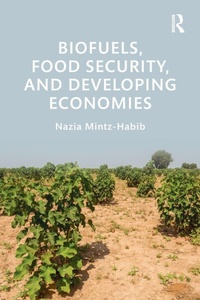
Biofuels, Food Security, and Developing Economies
1st Edition
Published on 10. April 2018
Book
Paperback/Softback
240 pages
978-1-138-58891-2 (ISBN)
Description
The last decade has witnessed major crises in both food and energy security across the world. One response to the challenges of climate change and energy supply has been the development of crops to be used for biofuels. But, as this book shows, this can divert agricultural land from food production to energy crops, thus affecting food security, particularly in less developed countries.
The author analyses the extent to which biofuels feedstocks fit within the national food security strategy, agro-export orientation, and rural development plans and policies of developing economies. Two case studies, from Tanzania in East Africa and Borneo in Malaysia, are considered in detail, using the non-edible crop of jatropha as an example of how compromises can be reached to balance food and energy goals as well as export markets. The author develops a novel integrated approach, the Institutional Feasibility Study, as the basis of her analysis.
She addresses key issues such as: how do global initiatives for green growth, energy security and sustainable development incorporate biofuels industry development? Does global biofuels trade present meaningful foreign and local investment opportunities for developing countries? To what extent does biofuels feedstock production help with poverty reduction and agricultural sector modernization? What role do the EU and the US commitments to biofuels blending targets play in the rapid industry development in developing countries? How does the biofuels industry fit within existing formal and informal institutional frameworks? Who are the winners and losers in the biofuels global value chain?
The author analyses the extent to which biofuels feedstocks fit within the national food security strategy, agro-export orientation, and rural development plans and policies of developing economies. Two case studies, from Tanzania in East Africa and Borneo in Malaysia, are considered in detail, using the non-edible crop of jatropha as an example of how compromises can be reached to balance food and energy goals as well as export markets. The author develops a novel integrated approach, the Institutional Feasibility Study, as the basis of her analysis.
She addresses key issues such as: how do global initiatives for green growth, energy security and sustainable development incorporate biofuels industry development? Does global biofuels trade present meaningful foreign and local investment opportunities for developing countries? To what extent does biofuels feedstock production help with poverty reduction and agricultural sector modernization? What role do the EU and the US commitments to biofuels blending targets play in the rapid industry development in developing countries? How does the biofuels industry fit within existing formal and informal institutional frameworks? Who are the winners and losers in the biofuels global value chain?
Reviews / Votes
"Nazia Mintz-Habib's fascinating study explores how, and in what circumstances, biofuel crops contribute to either perpetuating or alleviating poverty and food insecurity by considering the complex interactions among agricultural commodity and energy markets, climate change mitigation finance and farming communities." - Jomo Kwame Sundaram, Coordinator for Economic and Social Development, Food and Agriculture Organization of the United Nations."This book provides a highly original application of the Institutional Feasibility framework to the analysis of developing countries' role within global value chains in primary commodities. It makes a valuable contribution to public policy and development studies." - Peter Nolan, Chong Hua Professor and Director, Centre of Development Studies, University of Cambridge, UK.
More details
Series
Language
English
Place of publication
London
United Kingdom
Publishing group
Taylor & Francis Ltd
Target group
College/higher education
Illustrations
67 s/w Abbildungen
67 Illustrations, black and white
Dimensions
Height: 234 mm
Width: 156 mm
Thickness: 13 mm
Weight
371 gr
ISBN-13
978-1-138-58891-2 (9781138588912)
Copyright in bibliographic data and cover images is held by Nielsen Book Services Limited or by the publishers or by their respective licensors: all rights reserved.
Schweitzer Classification
Other editions
Additional editions
Nazia Mintz-Habib
Biofuels, Food Security, and Developing Economies
E-Book
01/2016
Routledge
€64.49
Available for download
Nazia Mintz-Habib
Biofuels, Food Security, and Developing Economies
E-Book
01/2016
Routledge
€64.49
Available for download
Nazia Mintz-Habib
Biofuels, Food Security, and Developing Economies
Book
01/2016
1st Edition
Routledge
€231.70
Shipment within 15-20 days
Person
Nazia Mintz-Habib is Lecturer in Public Policy at the University of Cambridge, UK. She was a Post-Doctoral Research Fellow in the Kennedy School of Government, Harvard University, USA, and also a Research Fellow in Development Studies at the University of Cambridge, UK.
Content
1. Introduction 2. An Innovative Framework 3. Biofuels, Biodiesel and Regulations 4. The Tanzanian Biofuels Experience 5. The Malaysian Biofuels Experience 6. Looking Forward while Leaning Backward 7. Conclusion