

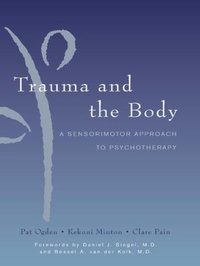
Trauma and the Body
A Sensorimotor Approach to Psychotherapy
Published on 17. October 2006
Book
Hardback
384 pages
978-0-393-70457-0 (ISBN)
Description
Psychotherapists who have been trained in models of psychodynamic, psychoanalytic, or cognitive therapeutic approaches are skilled at listening to the language and affect of the client. They track the clients' associations, fantasies, and signs of psychic conflict, distress, and defenses. Yet while the majority of therapists are trained to notice the appearance and even the movements of the client's body, thoughtful engagement with the client's embodied experience has remained peripheral to traditional therapeutic interventions. Trauma and the Body is a detailed review of research in neuroscience, trauma, dissociation, and attachment theory that points to the need for an integrative mind-body approach to trauma. The premise of this book is that, by adding body-oriented interventions to their repertoire, traditionally trained therapists can increase the depth and efficacy of their clinical work. Sensorimotor psychotherapy is an approach that builds on traditional psychotherapeutic understanding but includes the body as central in the therapeutic field of awareness, using observational skills, theories, and interventions not usually practiced in psychodynamic psychotherapy. By synthesizing bottom-up and top down interventions, the authors combine the best of both worlds to help chronically traumatized clients find resolution and meaning in their lives and develop a new, somatically integrated sense of self.
Topics addressed include:
Cognitive, emotional, and sensorimotor dimensions of information processing
modulating arousal
dyadic regulation and the body
the orienting response
defensive subsystems
adaptation and action systems
treatment principles
skills for working with the body in present time
developing somatic resources for stabilization
processing
Topics addressed include:
Cognitive, emotional, and sensorimotor dimensions of information processing
modulating arousal
dyadic regulation and the body
the orienting response
defensive subsystems
adaptation and action systems
treatment principles
skills for working with the body in present time
developing somatic resources for stabilization
processing
Reviews / Votes
"I strongly recommend this fascinating and essential reading...it offersclinicians of all orientations a variety of psychosomatic treatment
strategies." -- Julia Mueller - Journal of Psychosomatic Research "This book will be read and valued by researchers and clinicians alike, as well as academics and those who already practice body-oriented psychotherapies. This is a rare achievement. . . . [H]ighly recommended." -- PsycCritiques "[A]n exemplary collaboration within the village of traumatology....[G]rounded in the whole body of knowledge available to us about trauma....They also offer explanations of new concepts in clear language and couple the technical information with familiar ideas....Although clinicians in particular, will benefit from reading this book, it also will interest clients, researchers, and other mental health professionals....I highly recommend studying this book at a leisurely pace that allows for an integration of all that it offers." -- Clinical Social Work Journal "[A] significant addition to the literature on...mind-body medicine....[T]his sensible, respectful, non-anthologizing, step-by-step approach helps people create balance in their lives." -- Journal of Sex & Marital Therapy
More details
Series
Language
English
Place of publication
New York
United States
Target group
Professional and scholarly
Dimensions
Height: 246 mm
Width: 167 mm
Thickness: 40 mm
Weight
744 gr
ISBN-13
978-0-393-70457-0 (9780393704570)
Copyright in bibliographic data and cover images is held by Nielsen Book Services Limited or by the publishers or by their respective licensors: all rights reserved.
Schweitzer Classification
Other editions
Additional editions
E-Book
10/2006
W. W. Norton & Company
€50.49
Available for download
Persons
Kekuni Minton, Ph.D., is a faculty member at Naropa University. Pat Ogden, PhD, a pioneer in somatic psychology, is the founder of the Sensorimotor Psychotherapy Institute and the author of Sensorimotor Psychotherapy, Trauma and the Body, and The Pocket Guide to Sensorimotor Psychotherapy in Context. She lives in Boulder, Colorado. Clare Pain, M.D., is Assistant Professor of Psychiatry at the Universities of Toronto and Western Ontario. Daniel J. Siegel, MD, a noted neuropsychiatrist and bestselling author, is the cofounder of Mind Your Brain, the founder and director of education of the Mindsight Institute, and founding codirector of the Mindful Awareness Research Center at UCLA. He resides in Santa Monica, California.
Content
* Top-down and Bottom-up Psychotherapy: Hierarchical Information Processing
* From Pierre Janet to the 21st Century
* The Window of Tolerance: Self-Regulation and Information Processing
* Disrupted Memory of the Future: Traumatic Orienting and Defensive Responses
* Introduction to the Clinical Practice of Sensorimotor Psychotherapy
* Somatic Awareness: Body Sensation and Psychotherapy
* Working with the Organization of Experience: Tracking, Contact, and Accessing Mindfulness
* Tapping the Intelligence of the Body: Building Somatic Resources
* The Use of Touch
* A Somatic Approach to Phase Oriented Treatment
* Conclusion: Limitations and Future Directions
* From Pierre Janet to the 21st Century
* The Window of Tolerance: Self-Regulation and Information Processing
* Disrupted Memory of the Future: Traumatic Orienting and Defensive Responses
* Introduction to the Clinical Practice of Sensorimotor Psychotherapy
* Somatic Awareness: Body Sensation and Psychotherapy
* Working with the Organization of Experience: Tracking, Contact, and Accessing Mindfulness
* Tapping the Intelligence of the Body: Building Somatic Resources
* The Use of Touch
* A Somatic Approach to Phase Oriented Treatment
* Conclusion: Limitations and Future Directions