

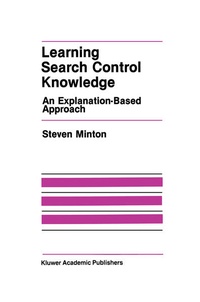
Learning Search Control Knowledge
An Explanation-Based Approach
Published on 5. October 2011
Book
Paperback/Softback
X, 214 pages
978-1-4612-8960-9 (ISBN)
Description
The ability to learn from experience is a fundamental requirement for intelligence. One of the most basic characteristics of human intelligence is that people can learn from problem solving, so that they become more adept at solving problems in a given domain as they gain experience. This book investigates how computers may be programmed so that they too can learn from experience. Specifically, the aim is to take a very general, but inefficient, problem solving system and train it on a set of problems from a given domain, so that it can transform itself into a specialized, efficient problem solver for that domain. on a knowledge-intensive Recently there has been considerable progress made learning approach, explanation-based learning (EBL), that brings us closer to this possibility. As demonstrated in this book, EBL can be used to analyze a problem solving episode in order to acquire control knowledge. Control knowledge guides the problem solver's search by indicating the best alternatives to pursue at each choice point. An EBL system can produce domain specific control knowledge by explaining why the choices made during a problem solving episode were, or were not, appropriate.
More details
Series
Edition
Softcover reprint of the original 1st ed. 1988
Language
English
Place of publication
New York
United States
Target group
Professional and scholarly
Research
Product notice
Paperback (trade)
Unsewn / adhesive bound
Illustrations
X, 214 p.
Dimensions
Height: 235 mm
Width: 155 mm
Thickness: 13 mm
Weight
353 gr
ISBN-13
978-1-4612-8960-9 (9781461289609)
DOI
10.1007/978-1-4613-1703-6
Schweitzer Classification
Other editions
Additional editions
E-Book
12/2012
Springer
€96.29
Available for download
Book
10/1988
Kluwer Academic Publishers
€106.99
Shipment within 3-4 weeks
Content
1. Introduction.- 2. Analyzing the Utility Problem.- 3. Overview of the PRODIGY Problem Solver.- 4. Specialization.- 5. Compression.- 6. Utility Evaluation.- 7. Learning from Success.- 8. Learning from Failure.- 9. Learning from Goal Interactions.- 10. Performance Results.- 11. Proofs, Explanations, and Correctness: Putting It All Together.- 12. Related Work.- 13. Conclusion.- Appendix: Domain Specifications Index.