

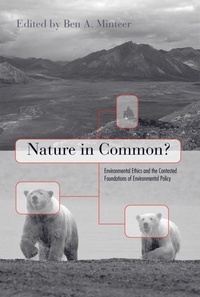
Nature in Common?
Environmental Ethics and the Contested Foundations of Environmental Policy
Will be published approx. on 15. April 2009
Book
Hardback
312 pages
978-1-59213-703-9 (ISBN)
Description
A groundbreaking contribution to a central debate in environmentalism
Reviews / Votes
"Nature in Common? brings together leading environmental philosophers to sharpen and clarify the divisions and critically examine the strengths and limits of moving environmentalists toward an agenda with which most can agree. This is an important and unique collection of essays. Minteer's introductory framing is excellent, and each of the chapters, are clear and forceful. This volume is a major contribution and deserves to be read widely. "-Jan Dizard, Charles Hamilton Houston Professor of American Culture and the Pick Professor of Environmental Studies, Amherst CollegeMore details
Language
English
Place of publication
Philadelphia PA
United States
Target group
College/higher education
Product notice
sewn/stitched
Paper over boards
Dimensions
Height: 229 mm
Width: 160 mm
Thickness: 25 mm
Weight
544 gr
ISBN-13
978-1-59213-703-9 (9781592137039)
Copyright in bibliographic data and cover images is held by Nielsen Book Services Limited or by the publishers or by their respective licensors: all rights reserved.
Schweitzer Classification
Person
Ben A. Minteer is Assistant Professor of Environmental Ethics and Policy in the School of Life Sciences and affiliated Assistant Professor of Philosophy at Arizona State University. He is author of The Landscape of Reform: Civic Pragmatism and Environmental Thought in America.
Content
Acknowledgments
PART I Introduction
1. Unity among Environmentalists? Debating the Values-Policy Link in Environmental Ethics
PART II The Convergence Hypothesis Debate in Environmental Ethics: The First Wave
2. Contextualism and Norton's Convergence Hypothesis
3. Convergence and Contextualism: Some Clarifications and a Reply to Steverson
4. Why Norton's Approach Is Insufficient for Environmental Ethics
5. Convergence in Environmental Values: An Empirical and Conceptual Defense
6. The Relevance of Environmental Ethical Theories for Policy Making
PART III Expanding the Discussion: The Convergence Hypothesis Debate Today
7. Converging versus Reconstituting Environmental Ethics
8. Environmental Ethics and Future Generations
9. The Convergence Hypothesis Falsified: Implicit Intrinsic Value, Operational Rights, and De Facto Standing in the Endangered Species Act
10. Convergence in an Agrarian Key
11. Convergence and Ecological Restoration: A Counterexample
12. Does a Public Environmental Philosophy Need a Convergence Hypothesis?
13. The Importance of Creating an Applied Environmental Ethics: Lessons Learned from Climate Change
14. Who Is Converging with Whom? An Open Letter to Professor Bryan Norton from a Policy Wonk
PART IV Reply by Bryan G. Norton
15. Convergence and Divergence: The Convergence Hypothesis Twenty Years Later
Contributors
Notes
Index
PART I Introduction
1. Unity among Environmentalists? Debating the Values-Policy Link in Environmental Ethics
PART II The Convergence Hypothesis Debate in Environmental Ethics: The First Wave
2. Contextualism and Norton's Convergence Hypothesis
3. Convergence and Contextualism: Some Clarifications and a Reply to Steverson
4. Why Norton's Approach Is Insufficient for Environmental Ethics
5. Convergence in Environmental Values: An Empirical and Conceptual Defense
6. The Relevance of Environmental Ethical Theories for Policy Making
PART III Expanding the Discussion: The Convergence Hypothesis Debate Today
7. Converging versus Reconstituting Environmental Ethics
8. Environmental Ethics and Future Generations
9. The Convergence Hypothesis Falsified: Implicit Intrinsic Value, Operational Rights, and De Facto Standing in the Endangered Species Act
10. Convergence in an Agrarian Key
11. Convergence and Ecological Restoration: A Counterexample
12. Does a Public Environmental Philosophy Need a Convergence Hypothesis?
13. The Importance of Creating an Applied Environmental Ethics: Lessons Learned from Climate Change
14. Who Is Converging with Whom? An Open Letter to Professor Bryan Norton from a Policy Wonk
PART IV Reply by Bryan G. Norton
15. Convergence and Divergence: The Convergence Hypothesis Twenty Years Later
Contributors
Notes
Index