

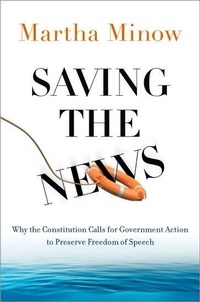
Saving the News
Why the Constitution Calls for Government Action to Preserve Freedom of Speech
Published on 5. October 2021
Book
Hardback
256 pages
978-0-19-094841-2 (ISBN)
Description
A detailed argument of how our government has interfered in the direction of America's media landscape that traces major transformations in media since the printing press and charts a path for reform.
In The Changing Ecosystem of the News, Martha Minow takes stock of the new media landscape. She focuses on the extent to which our constitutional system is to blame for the current parlous state of affairs and on our government's responsibilities for alleviating the problem. As Minow shows, the First Amendment of the US Constitution assumes the existence and durability of a private industry. Although the First Amendment does not govern the conduct of entirely private enterprises, nothing in the Constitution forecloses government action to regulate concentrated economic power, to require disclosure of who is financing communications, or to support news initiatives where there are market failures. Moreover, the federal government has contributed financial resources, laws, and regulations to develop and shape media in the United States. Thus, Minow argues that the transformation of media from printing presses to the internet was shaped by deliberate government policies that influenced the direction of private enterprise. In short, the government has crafted the direction and contours of America's media ecosystem.
Building upon this basic argument, Minow outlines an array of reforms, including a new fairness doctrine, regulating digital platforms as public utilities, using antitrust authority to regulate the media, policing fraud, and more robust funding of public media. As she stresses, such reforms are not merely plausible ideas; they are the kinds of initiatives needed if the First Amendment guarantee of freedom of the press continues to hold meaning in the twenty-first century.
In The Changing Ecosystem of the News, Martha Minow takes stock of the new media landscape. She focuses on the extent to which our constitutional system is to blame for the current parlous state of affairs and on our government's responsibilities for alleviating the problem. As Minow shows, the First Amendment of the US Constitution assumes the existence and durability of a private industry. Although the First Amendment does not govern the conduct of entirely private enterprises, nothing in the Constitution forecloses government action to regulate concentrated economic power, to require disclosure of who is financing communications, or to support news initiatives where there are market failures. Moreover, the federal government has contributed financial resources, laws, and regulations to develop and shape media in the United States. Thus, Minow argues that the transformation of media from printing presses to the internet was shaped by deliberate government policies that influenced the direction of private enterprise. In short, the government has crafted the direction and contours of America's media ecosystem.
Building upon this basic argument, Minow outlines an array of reforms, including a new fairness doctrine, regulating digital platforms as public utilities, using antitrust authority to regulate the media, policing fraud, and more robust funding of public media. As she stresses, such reforms are not merely plausible ideas; they are the kinds of initiatives needed if the First Amendment guarantee of freedom of the press continues to hold meaning in the twenty-first century.
Reviews / Votes
What the book does do rather successfully is destroy the myth that any and all forms of support for the media will necessarily undermine democracy and speech freedom. * Damian Tambini, Distinguished Policy Fellow, and Associate Professor in the Department of Media and Communications at LSE, E-International Relations * What is remarkable about Martha Minow's book is that she is pragmatic about the enormous potential that this new form of content curation brings to society ... The need to regulate using the First Amendment as the guiding principle that Minow has so meticulously articulated in the book bears testimony to this unflinching zeal to preserve the cornerstones of democratic ideals, which are under serious threat in contemporary times. * Dr. Shameek Sen, Journal of Indian Law and Society * Thoughtful proposals for protecting the integrity of news...Minow underscores the urgency of restoring public interest to communications policy. * Kirkus *More details
Series
Language
English
Place of publication
New York
United States
Product notice
sewn/stitched
Cloth over boards
Dimensions
Height: 215 mm
Width: 143 mm
Thickness: 27 mm
Weight
414 gr
ISBN-13
978-0-19-094841-2 (9780190948412)
Copyright in bibliographic data and cover images is held by Nielsen Book Services Limited or by the publishers or by their respective licensors: all rights reserved.
Schweitzer Classification
Other editions
Additional editions
Martha Minow
Saving the News
Why the Constitution Calls for Government Action to Preserve Freedom of Speech
E-Book
06/2021
1st Edition
OUP eBook
€9.99
Available for download
Martha Minow
Saving the News
Why the Constitution Calls for Government Action to Preserve Freedom of Speech
E-Book
06/2021
1st Edition
OUP eBook
€9.99
Available for download
Person
Martha Minow is Professor of Law and former Dean of Harvard Law School. She is the author of In Brown's Wake (Oxford, 2010).
Content
Preface, by Newton Minow
Introduction
Chapter 1: News Deserts, Echo Chambers, Algorithmic Editors, and the Siren Call of Revenues
Chapter 2: News Production and Distribution in the United States: Private Industry and Government Contributions
Chapter 3: Does the First Amendment Forbid, Permit, or Require Government Support of News Industries
Chapter 4: Constitutionally Inflected Reforms
Coda
Notes
Index
Introduction
Chapter 1: News Deserts, Echo Chambers, Algorithmic Editors, and the Siren Call of Revenues
Chapter 2: News Production and Distribution in the United States: Private Industry and Government Contributions
Chapter 3: Does the First Amendment Forbid, Permit, or Require Government Support of News Industries
Chapter 4: Constitutionally Inflected Reforms
Coda
Notes
Index