


The Evil of Banality
On the Life and Death Importance of Thinking, Expanded Edition
Published on 5. November 2024
Book
Hardback
294 pages
979-8-8818-0290-5 (ISBN)
Description
In this expanded edition of The Evil of Banality, Elizabeth Minnich argues for a tragic yet hopeful explanation of "extensive evil," her term for systematic, normalized harm-doing on the scale of genocide, slavery, sexualized dominance. The book now includes a new preface, new chapter, and expanded afterword addressing ongoing extensive evils, the paradox of lying, and the importance of developing the thinking without which conscience remains mute.
Extensive evils are actually carried out not by psychopaths, but by people like your quiet next-door neighbor, your ambitious colleagues. There simply are not enough moral monsters to do the long hard work of extensive evils, nor enough saints for extensive good. In periods of extensive evil, people little different from you and me do its work for no more than a better job, a raise, the house of the family "disappeared" last week.
So how can there be hope? Such evils are neither mysterious nor demonic. If we avoid romanticizing both the worst and best of which humans are capable, we can recognize and say no to extensive evil, practice and sustain extensive good, where they must take root - in ordinary lives.
Extensive evils are actually carried out not by psychopaths, but by people like your quiet next-door neighbor, your ambitious colleagues. There simply are not enough moral monsters to do the long hard work of extensive evils, nor enough saints for extensive good. In periods of extensive evil, people little different from you and me do its work for no more than a better job, a raise, the house of the family "disappeared" last week.
So how can there be hope? Such evils are neither mysterious nor demonic. If we avoid romanticizing both the worst and best of which humans are capable, we can recognize and say no to extensive evil, practice and sustain extensive good, where they must take root - in ordinary lives.
Reviews / Votes
This expanded edition of The Evil of Banality, which I greatly admire, could hardly be more timely. The whole matter of evil being done thoughtlessly looms larger in every day's headlines. The book, in its wide-ranging display of the dangers of mindless complicity as well as complacency in the face of spreading chaos, is essential reading for today. Read this book. It will lighten your way in the darkness of our times. -- Jeremy Kohn, TrusteeMore details
Edition
Enlarged edition
Language
English
Place of publication
United States
Publishing group
Bloomsbury Publishing Plc
Target group
Professional and scholarly
Edition type
Enlarged edition
Dimensions
Height: 235 mm
Width: 157 mm
Thickness: 22 mm
Weight
634 gr
ISBN-13
979-8-8818-0290-5 (9798881802905)
Copyright in bibliographic data and cover images is held by Nielsen Book Services Limited or by the publishers or by their respective licensors: all rights reserved.
Schweitzer Classification
Other editions
Additional editions
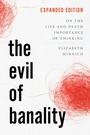
Elizabeth K. Minnich
The Evil of Banality
On the Life and Death Importance of Thinking, Expanded Edition
E-Book
10/2024
Rowman & Littlefield Publishers
€33.49
Available for download
Elizabeth K. Minnich
The Evil of Banality
On the Life and Death Importance of Thinking, Expanded Edition
E-Book
10/2024
Rowman & Littlefield Publishers
€33.49
Available for download
Person
Elizabeth Minnich received her doctorate from the Graduate Faculty of The New School under the direction of Hannah Arendt, whom she served as teaching assistant. Following twenty-five years as professor at the Union Institute, she was appointed Distinguished Fellow, President's Office, the AmericanAssociation of Colleges and Universities. She is the author of Transforming Knowledge and co-author of The Fox in the Henhouse: How Privatization Threatens Democracy.
Content
Acknowledgments
Preface to the Expanded Edition: If Not Now, When?
Introduction: What Were They Thinking?
PART I: EVIL-THINKING THE UNTHINKABLE
Chapter 1: Truth and Fiction: Camus' The Plague
Chapter 2: Thinking about Not-Thinkingh
Chapter 3: Changing Minds
Chapter 4: Escaping Explanations, Excuses
Chapter 5: Meaning, Truth, Rationality, Knowledge, and Thinking
Chapter 6: Romanticizing Evil
Chapter 7: Intensive Evil, Extensive Evil
Chapter 8: The Ordinary for Good and Ill
PART II: GOODNESS: WHAT IS TO BE DONE?
Chapter 9: Phillip Hallie: It Takes a Village
Chapter 10: Preparing for Extensive Goodness?
Chapter 11: Looking for Good Beyond the Village
Chapter 12: The Banality of Goodness?
PART III: FERTILE GROUNDS FOR EXTENSIVE EVIL
Chapter 13: Seeding Prepared Ground
Chapter 14: Large-Scale Enclosures: Meaning Systems
Chapter 15: Physical Enclosures of Bodies, Minds
Chapter 16: Laying out the Strands
Chapter 17: Why Not Lie?
Expanded Afterword: Teaching Thinking
Notes
Bibliography: Sources and Resources
Index
Author Biography
Preface to the Expanded Edition: If Not Now, When?
Introduction: What Were They Thinking?
PART I: EVIL-THINKING THE UNTHINKABLE
Chapter 1: Truth and Fiction: Camus' The Plague
Chapter 2: Thinking about Not-Thinkingh
Chapter 3: Changing Minds
Chapter 4: Escaping Explanations, Excuses
Chapter 5: Meaning, Truth, Rationality, Knowledge, and Thinking
Chapter 6: Romanticizing Evil
Chapter 7: Intensive Evil, Extensive Evil
Chapter 8: The Ordinary for Good and Ill
PART II: GOODNESS: WHAT IS TO BE DONE?
Chapter 9: Phillip Hallie: It Takes a Village
Chapter 10: Preparing for Extensive Goodness?
Chapter 11: Looking for Good Beyond the Village
Chapter 12: The Banality of Goodness?
PART III: FERTILE GROUNDS FOR EXTENSIVE EVIL
Chapter 13: Seeding Prepared Ground
Chapter 14: Large-Scale Enclosures: Meaning Systems
Chapter 15: Physical Enclosures of Bodies, Minds
Chapter 16: Laying out the Strands
Chapter 17: Why Not Lie?
Expanded Afterword: Teaching Thinking
Notes
Bibliography: Sources and Resources
Index
Author Biography