

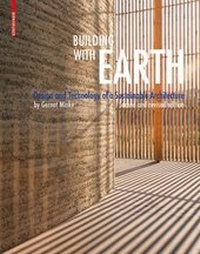
Building with Earth
Design and Technology of a Sustainable Architecture
2nd Edition
Published on 16. January 2009
Book
Hardback
208 pages
978-3-7643-8992-5 (ISBN)
Description
For a number of years, the healthy and environment-friendly building material earth, in common use for thousands of years, has been enjoying increasing popularity, including in industrialized nations. In hot dry and temperate climate zones, earth offers numerous advantages over other materials. Its particular texture and composition also holds great aesthetic appeal. The second and revised edition of this handbook offers a practical systematic overview of the many uses of earth and techniques for processing it. Its properties and physical characteristics are described in informed and knowledgeable detail. The author's presentation reflects the rich and varied experiences gained over thirty years of building earth structures all over the world. Numerous photographs of construction sites and drawings show the concrete execution of earth architecture. Der ressourcenschonende und gesunde Baustoff Lehm, seit Jahrtausenden gebräuchlich, erfreut sich seit vielen Jahren auch in den Industrienationen wachsender Beliebtheit. In gemäßigten und trocken-heißen Klimazonen bietet der Lehm zahlreiche Vorteile gegenüber anderen Materialien. Seine spezifische Beschaffenheit und Textur ist außerdem von hohem ästhetischem Reiz. Die neue und erweiterte 2. Auflage dieses Handbuchs bietet einen praxisorientierten systematischen Überblick über die zahlreichen Einsatzmöglichkeiten und Verarbeitungstechniken von Lehm; seine Eigenschaften und physikalischen Gegebenheiten werden detailliert und kenntnisreich erläutert. Die reichhaltigen Erfahrungen, die der Autor bei der Ausführung von Lehmbauten im In- und Ausland über 30 Jahre gewinnen konnte, spiegeln sich in seiner Darstellung wieder. Zahlreiche Baustellenfotos und Zeichnungen zeigen die konkrete Umsetzung von Lehm-Architektur.
More details
Edition
2nd, rev. ed.
Language
English
Place of publication
Basel/Berlin/Boston
Switzerland
Target group
Professional and scholarly
US School Grade: College Graduate Student
Edition type
New edition
Illustrations
496
90 farbige Abbildungen, 496 s/w Abbildungen
496 b/w and 90 col. ill.
Dimensions
Height: 28 cm
Width: 22 cm
ISBN-13
978-3-7643-8992-5 (9783764389925)
Schweitzer Classification
Other editions
New editions
Gernot Minke
Building with Earth
Design and Technology of a Sustainable Architecture Fifth and revised edition
Book
03/2025
5th Edition
Birkhäuser
€54.00
Available immediately
Book
11/2012
3rd Edition
Birkhäuser Verlag GmbH
€22.95
Article exhausted; check for reprint
Additional editions
E-Book
02/2013
2nd Edition
Birkhäuser
€52.95
Available for download
Book
05/2006
1st Edition
Birkhäuser Verlag GmbH
€49.95
Article exhausted; check for reprint
Person
Prof. Dr. Gernot Minke is a professor at Universität Kassel, where he leads the Forschungslabor für Experimentelles Bauen. He has long concerned himself with developments in ecological building, and he has dealt with the building material clay in theory and practice since 1977. His book Building with Straw was also published by Birkhäuser.
Prof. Dr.-Ing. Gernot Minke ist Hochschullehrer an der Universität Kassel, wo er das Forschungslabor für Experimentelles Bauen leitet und sich seit langem mit Entwicklungen des ökologischen Bauens beschäftigt. Mit dem Baustoff Lehm befaßt er sich in Theorie und Praxis seit 1977. Sein Buch «Building with Straw» ist ebenfalls bei Birkhäuser erschienen.
Prof. Dr.-Ing. Gernot Minke ist Hochschullehrer an der Universität Kassel, wo er das Forschungslabor für Experimentelles Bauen leitet und sich seit langem mit Entwicklungen des ökologischen Bauens beschäftigt. Mit dem Baustoff Lehm befaßt er sich in Theorie und Praxis seit 1977. Sein Buch «Building with Straw» ist ebenfalls bei Birkhäuser erschienen.
Content
Preface I The Technology of Earth Building 1. Introduction 2. The properties of earth as a building material 3. Preparing of loam 4. Improving the earth's characteristics by special treatment or additives 5. Rammed earthworks 6. Working with earthern blocks 7. Large blocks and prefabricated panels 8. Direct forming with wet loam 9. Wet loam infill in skeleton structures 10. Tamped, poured or pumped lightweight loam 11. Loam plasters 12. Weather protection of loam surfaces 13. Repair of loam components 14. Designs of particular building elements 15. Earthquake-resistant building II Built Examples Residences Cultural, Educational and Sacral Buildings III Appendix Future prospects Measures Bibliographical references Acknowledgements Illustration credits