

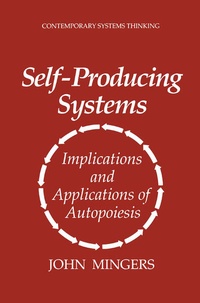
Self-Producing Systems
Implications and Applications of Autopoiesis
Published on 31. May 2013
Book
Paperback/Softback
XVII, 246 pages
978-1-4899-1024-0 (ISBN)
Description
John Mingers' new volume, Self-Producing Systems: Implications and Ap plications of Autopoiesis, is a much-needed reference on autopoiesis, a subject penetrating many disciplines today. I can genuinely say that I enjoyed reading the book as it took me stage by stage through a clear and easy-to-grasp understanding of the concepts and ideas of auto poiesis and then, as the book's title suggests, on through their applica tions. I found the summary in Chapter 12 particularly useful, helping to crystalize the main points of each chapter. The book conveyed enthusi asm for the subject and stimulated my interest in it. At times the book is demanding, but only because of the breadth of the subject matter, the terms and concepts associated with its parts, and the challenge of keep ing hold of all this in the mind at once. This is an exceptional text. ROBERT L. FLOOD Hull, UK Preface In recent years Maturana's and Varela's concept of autopoiesis, origi nally a biological concept, has made a remarkable impact not just on a single area, but across widely differing disciplines such as sociology, policy science, psychotherapy, cognitive science, and law. Put very briefly, the term autopoiesis connotes the idea that certain types of sys tems exist in a particular manner-they are self-producing systems. In their operations they continuously produce their own constituents, their own components, which then participate in these same production pro cesses.
Reviews / Votes
` A much-needed reference on autopoiesis...I enjoyed reading the book as it took me stage by stage through a clear and easy-to-grasp understanding of the concepts and ideas of autopoiesis...on through their applications....an exceptional text. 'from the Foreword by Robert L. Flood
More details
Series
Edition
Softcover reprint of the original 1st ed. 1995
Language
English
Place of publication
New York
United States
Target group
Professional and scholarly
Research
Illustrations
XVII, 246 p.
Dimensions
Height: 235 mm
Width: 155 mm
Thickness: 15 mm
Weight
411 gr
ISBN-13
978-1-4899-1024-0 (9781489910240)
DOI
10.1007/978-1-4899-1022-6
Schweitzer Classification
Other editions
Additional editions
Book
12/1994
Plenum Publishing Co.,N.Y.
€160.49
Shipment within 10-15 days
Person
John Mingers is Emeritus Professor at Kent Business School, University of Kent, UK, where he was previously Professor of Operational Research and Information Systems. He has an international reputation for his work on research metrics, the nature of information, meaning and knowledge, the use of systems methodologies in problem situations - multimethodology, and the philosophy of critical realism. He has published widely in books and journals.
Leslie Willcocks is Emeritus Professor at London School of Economics and Political Science and is an Associate Fellow of Green Templeton College, University of Oxford, UK. He has an international reputation for his work on automation and the future of work, ITO/BPO outsourcing, cloud computing, digital business, strategy, automation, IT and innovation, organisational change and global business management. He was previously Professor in Technology Work and Globalization at the Department of Management. He has published widely in books and journals and is a Series Editor of the Technology, Work and Globalization book series with Palgrave Macmillan.
Content
1. The Development of Autopoiesis.- I. Autopoiesis in the Physical Domain.- 2. The Organization of Living Systems.- 3. The Implications of Autopoiesis.- 4. Mathematics and Models of Autopoiesis.- II. Theories of Cognition.- 5. The Organization of the Nervous System.- 6. Language and the Emergence of the Observer.- 7. Philosophical Implications.- III. Applications of Autopoiesis.- 8. Autopoietic Organizations and Social Systems.- 9. Law as an Autopoietic System.- 10. Family Therapy.- 11. Information Systems, Cognitive Science, and Artificial Intelligence.- IV. Conclusions.- 12. Conclusions.- Name Index.