

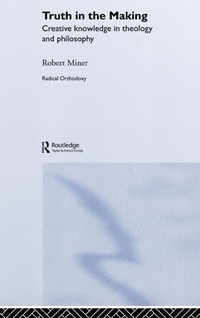
Truth in the Making
Creative Knowledge in Theology and Philosophy
1st Edition
Published on 25. September 2003
Book
Hardback
192 pages
978-0-415-27697-9 (ISBN)
Description
Is knowing a purely passive reception of something concrete outside the mind, or when we know something, are we creating something too?
Spanning more than 500 years of philosophical enquiry from the Middle Ages to the present day, Robert Miner clarifies modern philosophical conceptions of knowing as making or constructing, and contrasts this view with the theological understanding of knowing as a participation in divine creation.
This study demonstrates how 'creative knowledge' has its roots in the theologies of Thomas Aquinas and Nicholas Cusanus. It explores the multiple ways in which this idea influenced the architects of modern philosophy, most notably Francis Bacon, Rene Descartes and Thomas Hobbes, despite their secular stance. Miner contends that, well in advance of Kant, one of these thinkers, Gaimbattista Vico provided a remarkably succinct formulation of the metaphysical and epistemological core of modernity in his principle verum et factum convertuntur: 'the true and the made are convertible'.
In Truth in the Making, Robert Miner challenges the standard assumption that Kant was the first thinker to conceive of knowing as constructive activity, and shows how contemporary theology can reclaim a concept of knowing that is both creative and participant in divine wisdom.
Spanning more than 500 years of philosophical enquiry from the Middle Ages to the present day, Robert Miner clarifies modern philosophical conceptions of knowing as making or constructing, and contrasts this view with the theological understanding of knowing as a participation in divine creation.
This study demonstrates how 'creative knowledge' has its roots in the theologies of Thomas Aquinas and Nicholas Cusanus. It explores the multiple ways in which this idea influenced the architects of modern philosophy, most notably Francis Bacon, Rene Descartes and Thomas Hobbes, despite their secular stance. Miner contends that, well in advance of Kant, one of these thinkers, Gaimbattista Vico provided a remarkably succinct formulation of the metaphysical and epistemological core of modernity in his principle verum et factum convertuntur: 'the true and the made are convertible'.
In Truth in the Making, Robert Miner challenges the standard assumption that Kant was the first thinker to conceive of knowing as constructive activity, and shows how contemporary theology can reclaim a concept of knowing that is both creative and participant in divine wisdom.
Reviews / Votes
'The book ... can be recommended as an important historical perspective that is vital to any informed understanding of contemporary discourse concerning the source(s) of our knowing.' - The Expository Times' ... [Robert Miner] has written a book that is as careful as it is ambitious ... the delight of this book is in the details.' -
' ... Truth in the Making offers useful expositions of important thinkers ...' - Church Times
'...Truth in the Making tells a compelling story.'- The Thomist
More details
Series
Language
English
Place of publication
London
United Kingdom
Publishing group
Taylor & Francis Ltd
Target group
College/higher education
General
Dimensions
Height: 235 mm
Width: 157 mm
Thickness: 15 mm
Weight
429 gr
ISBN-13
978-0-415-27697-9 (9780415276979)
Copyright in bibliographic data and cover images is held by Nielsen Book Services Limited or by the publishers or by their respective licensors: all rights reserved.
Schweitzer Classification
Other editions
Additional editions
E-Book
02/2013
1st Edition
Routledge
€55.49
Available for download
E-Book
02/2013
1st Edition
Routledge
€55.49
Available for download
Book
09/2003
1st Edition
Routledge
€62.90
Shipment within 15-20 days
Person
Robert Miner is Assistant Professor of Philosophy in the Honors College at Baylor University. He has published widely on the history of modern philosophy and is the author or Vico, Genealogist of Modernity.
Content
Prologue 1. Thomas Aquinas 2. Nicolaus Cusanus 3. Francis Bacon 4. Rene Descartes 5. Thomas Hobbes 6. Giambattiata Vico Epilogue