

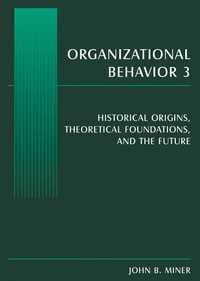
Organizational Behavior 3
Historical Origins, Theoretical Foundations, and the Future
1st Edition
Published on 15. May 2006
Book
Paperback/Softback
334 pages
978-0-7656-1528-2 (ISBN)
Description
This is the first comprehensive overview of the development of the field of Organizational Behavior. It belongs on the shelf of every scholar and student in the discipline.
Reviews / Votes
"The state of the art of organizational behaviour theories" Academy of Management ReviewMore details
Language
English
Place of publication
London
United Kingdom
Publishing group
Taylor & Francis Ltd
Target group
College/higher education
Professional and scholarly
Edition type
Revised edition
Illustrations
tables, figures, references, index
Dimensions
Height: 254 mm
Width: 178 mm
Weight
589 gr
ISBN-13
978-0-7656-1528-2 (9780765615282)
Copyright in bibliographic data and cover images is held by Nielsen Book Services Limited or by the publishers or by their respective licensors: all rights reserved.
Schweitzer Classification
Other editions
Additional editions

Book
05/2006
1st Edition
Routledge
€297.12
Shipment within 15-20 days
E-Book
03/2006
3rd Edition
Routledge
€77.99
Available for download
E-Book
03/2006
3rd Edition
Routledge
€77.99
Available for download
Person
Jack Miner has written more than 50 books and over 140 articles in leading journals. He is a Fellow and Past President of the Academy of Management and also a Fellow of the American Psychological Association.
Content
I: Theory, Research, and Knowledge of Organizational Behavior; 1: Science and its Theory; 2: Theory Building and Kinds of Theories; 3: Measurement of Variables and design of Research; 4: Knowledge of Organizational Behavior; 5: The Context of Theory as organizational Behavior Emerged; II: Multidisciplinary Origins of Organizational Behavior; 6: Elton Mayo And Hawthorne; 7: Chester Barnard's Views On Management; 8: Kurt Lewin-Personality Theory Andsocial Psychology Arrive; 9: Mary Parker Follett-Socialphilosopher And Prophetof Management; 10: Max Weber And Histheory Of Bureaucracy; 11: Classical Management Theorists: The Antiheroes-Henri Fayol Andfrederick Taylor; III: Establishing the Groundagainst which Organizational behavior became Figure; 12: The Foundations, Their Reports, and the Aftermath; 13: The Management Laureates; 14: Psychologists in Business Schools; 15: The Uncertainty Factor; 16: A Personal and Theoretical Odyssey; IV: The Importance, Validity, Practical Usefulness, and Institutionalization of Organizational Behavior Theories; 17: Methodology of the Importance, Validity, and Usefulness Analyses; 18: Findings From the Importance, Validity, and Usefulness Analyses; 19: Background and Hypotheses for the Institutionalization Analyses; 20: Methodology of the Institutionalization Analyses; 21: Findings From the Institutionalization Analyses; V: From Generation to Generation; 22: The Historical Core and Inherent Identity of Organizational Behavior; 23: A Vision for Ensuing Generations