

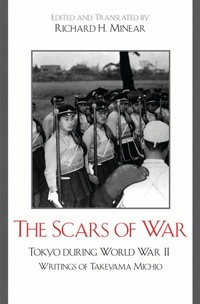
The Scars of War
Tokyo during World War II: Writings of Takeyama Michio
Will be published approx. on 9. July 2007
Book
Paperback/Softback
238 pages
978-0-7425-5480-1 (ISBN)
Description
Takeyama Michio, the author of Harp of Burma, was thirty-seven in 1941, the year of the Japanese attack on Pearl Harbor. Husband, father of children born during the war, and teacher at Japan's elite school of higher education in Tokyo, he experienced the war on its home front. His essays provide us with a personal record of the bombing of Tokyo, the shortage of food, the inability to get accurate information about the war, the frictions between civilians and military and between his elite students and other civilians, the mobilization of students into factory jobs and the military, and the relocation of civilians out of the Tokyo area. This intimate account of the "scars of war," including personal anecdotes from Takeyama's students and family, is one of very few histories from this unique vantage point. Takeyama's writings educate readers about how the war affected ordinary Japanese and convey his thoughts about Japan's ally Germany, the Tokyo War Crimes Trial, and the immediate postwar years. Beautifully translated by Richard H. Minear, these honest and moving essays are a fresh look at the history of Japan during the Asia-Pacific War.
Reviews / Votes
Readers can see the real picture of what Japan's intelligentsia experienced and what their thoughts were in those days. The essays are superbly well translated. A must. . . . Highly recommended. All levels/libraries. * Choice Reviews * The essays Minear has selected and masterfully translated for this volume testify to the workings of a splendid mind in search of understanding a world in turmoil. * The Japan Times * Historians now think of World War II not just in terms of battlefield winners and losers but also as an event that transformed civilian lives and national societies in profound ways. Richard Minear brings us one eloquent, thoughtful chronicler of these transformations, reminding us of the varied and distinctive ways Japanese people coped with the many meanings of the wartime and apres-guerre eras. Takeyama Michio was cantankerous, elitist, and contrary but also someone who intelligently and passionately searched for his own way to make sense of the turbulent times in which he lived. -- Laura Hein, Northwestern University A masterful translation of ten essays by one of postwar Japan's most interesting thinkers, this work ought to dispel our simplistic notions of Japan as a nation of unthinking followers during World War II. The complexity-and sharp turnings-of Takeyama's own ideas are troubling and provocative. And his vivid descriptions of ordinary people during the war-housewives stealing food to feed their hungry children, pampered and hedonistic Higher School boys scandalizing patriotic Hitachi factory workers, soldiers in China dying of boredom rather than battle-make the war somberly, but richly, human. -- James L. Huffman, Wittenberg University No one has been as assiduous as Richard Minear in pursuing the hard moral questions of World War II-on both sides of the Pacific. This portrait of a committed humanist under simultaneous siege by enemy bombs and his own country's rabid nationalism is both startling and heartbreaking. -- Jay Rubin, Harvard UniversityMore details
Series
Language
English
Place of publication
United States
Publishing group
Bloomsbury Publishing Plc
Product notice
Paperback (trade)
Unsewn / adhesive bound
Dimensions
Height: 228 mm
Width: 154 mm
Thickness: 24 mm
Weight
377 gr
ISBN-13
978-0-7425-5480-1 (9780742554801)
Copyright in bibliographic data and cover images is held by Nielsen Book Services Limited or by the publishers or by their respective licensors: all rights reserved.
Schweitzer Classification
Other editions
Additional editions
E-Book
07/2007
1st Edition
Rowman & Littlefield Publishers
€40.49
Available for download
Person
Richard H. Minear is professor of history at the University of Massachusetts Amherst and translator of Japan's Past, Japan's Future: One Historian's Odyssey.
Content
Introduction: Takeyama Michio, 1904-1981, by Richard H. Minear
The Writings
Part I: The War
Ichiko in 1944 (1946)
The End of the War (1953)
White Pine and Rose (1947)
Scars (1949)
Part II: Crisis and Challenge
Germany-New Middle Ages? (1940)
The Younger Generation (1945)
Part III: The Tokyo Trial
The Trial of Mr. Hyde (1946)
Letter to Judge Roeling (1949)
Part IV: Turn to the Right
The Student Incident: Observations and Reflections (1950)
Those Who Refuse to Enter the Gate-Thoughts on One Contemporary Frame of Mind (1951)
The Writings
Part I: The War
Ichiko in 1944 (1946)
The End of the War (1953)
White Pine and Rose (1947)
Scars (1949)
Part II: Crisis and Challenge
Germany-New Middle Ages? (1940)
The Younger Generation (1945)
Part III: The Tokyo Trial
The Trial of Mr. Hyde (1946)
Letter to Judge Roeling (1949)
Part IV: Turn to the Right
The Student Incident: Observations and Reflections (1950)
Those Who Refuse to Enter the Gate-Thoughts on One Contemporary Frame of Mind (1951)