

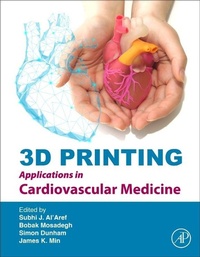
3D Printing Applications in Cardiovascular Medicine
Published on 6. July 2018
Book
Hardback
300 pages
978-0-12-803917-5 (ISBN)
Description
3D Printing Applications in Cardiovascular Medicine addresses the rapidly growing field of additive fabrication within the medical field, in particular, focusing on cardiovascular medicine. To date, 3D printing of hearts and vascular systems has been largely reserved to anatomic reconstruction with no additional functionalities. However, 3D printing allows for functional, physiologic and bio-engineering of products to enhance diagnosis and treatment of cardiovascular disease. This book contains the state-of-the-art technologies and studies that demonstrate the utility of 3D printing for these purposes.
More details
Language
English
Place of publication
San Diego
United States
Publishing group
Elsevier Science Publishing Co Inc
Target group
College/higher education
Professional and scholarly
Product notice
sewn/stitched
Cloth over boards
Dimensions
Height: 246 mm
Width: 200 mm
Thickness: 22 mm
Weight
794 gr
ISBN-13
978-0-12-803917-5 (9780128039175)
Copyright in bibliographic data and cover images is held by Nielsen Book Services Limited or by the publishers or by their respective licensors: all rights reserved.
Schweitzer Classification
Other editions
Additional editions
James K. Min MD | Bobak Mosadegh | Simon Dunham Materials Science and Engineering
3D Printing Applications in Cardiovascular Medicine
E-Book
07/2018
Academic Press
€113.00
Available for download
Persons
Dr. James K. Min specializes in the diagnosis of coronary heart disease with multi-detector CT angiography. He also has expertise in the identification novel clinical risk factors that place individuals at higher risk for the development of coronary heart disease.
Between 2010-2014 Dr. Min published 197 publications, with 93.4% in the Medicine category. He has an h-index of 40. He has 3,910 citations, a 3.59 FWCI and averages 19.8 citations per publication during this same time frame. 49% of his publications appear in the top 10% most cited publications worldwide.
Dr . Min has experience with international, national, and institutional collaboration having worked with 150 co-authors. He also has experience with single authorship. Dr. Bobak Mosadegh uses interdisciplinary approaches to develop novel technologies for biomedical applications, particularly for cardiovascular diseases, cancer, and implantable/wearable therapeutics. His lab has specific interests in exploiting the properties of polymers and fluids to develop soft machines with integrated "smart? behaviors. These soft machines use technologies related to microfluidics, soft robotics, and 3D cell culture. As of 2017, Dr. Mosadegh published 42 publications throughout various disciplines. He has an h-index of 28, and over 2500 citations. From 2010-2014, Dr. Mosadegh has a 2.75 FWCI and averages 16 citations per publication during this same time frame. 63.2% of his publications appear in the top 10% most cited publications worldwide. Dr. Mosadegh has experience with international, national, and institutional collaboration having worked with over 100 co-authors. Dr. Dunham's research centers on the development and testing of novel cardiovascular medical devices. His lab employs the use of soft materials, 3D printing, biomimicry, functional materials and flexible electronics to develop devices and tests methods with embedded functionality, sensing and other unique functionalities. Since joining the Dalio Institute for Cardiovascular Imaging at Weill Cornell Medicine, these efforts have been focused primarily on cardiovascular medicine. Between 2010-2014, Dr. Dunham published 12 papers across various disciplines. He has an h-index of 8 and 335 citations during that period of time. Dr. Subhi Al'Aref is an Instructor in Medicine and an Instructor of Medicine in Radiology at Weill Cornell Medicine and an Assistant Attending Physician at the NewYork-Presbyterian Hospital. Dr. Al'Aref was born and raised in Jerusalem, where he finished his primary and secondary education. He subsequently performed his premedical and medical training at Weill Cornell Medical College in Qatar, and earned his M.D. in 2008. He completed his training in Internal Medicine Residency, Cardiovascular Disease Fellowship, Interventional Cardiology and Preventative Cardiology at The NewYork-Presbyterian Hospital/Weill Cornell Medicine in New York City. He is board certified in Internal Medicine, Cardiovascular Disease, Interventional Cardiology, Vascular Medicine, Echocardiography and Nuclear Cardiology.
Between 2010-2014 Dr. Min published 197 publications, with 93.4% in the Medicine category. He has an h-index of 40. He has 3,910 citations, a 3.59 FWCI and averages 19.8 citations per publication during this same time frame. 49% of his publications appear in the top 10% most cited publications worldwide.
Dr . Min has experience with international, national, and institutional collaboration having worked with 150 co-authors. He also has experience with single authorship. Dr. Bobak Mosadegh uses interdisciplinary approaches to develop novel technologies for biomedical applications, particularly for cardiovascular diseases, cancer, and implantable/wearable therapeutics. His lab has specific interests in exploiting the properties of polymers and fluids to develop soft machines with integrated "smart? behaviors. These soft machines use technologies related to microfluidics, soft robotics, and 3D cell culture. As of 2017, Dr. Mosadegh published 42 publications throughout various disciplines. He has an h-index of 28, and over 2500 citations. From 2010-2014, Dr. Mosadegh has a 2.75 FWCI and averages 16 citations per publication during this same time frame. 63.2% of his publications appear in the top 10% most cited publications worldwide. Dr. Mosadegh has experience with international, national, and institutional collaboration having worked with over 100 co-authors. Dr. Dunham's research centers on the development and testing of novel cardiovascular medical devices. His lab employs the use of soft materials, 3D printing, biomimicry, functional materials and flexible electronics to develop devices and tests methods with embedded functionality, sensing and other unique functionalities. Since joining the Dalio Institute for Cardiovascular Imaging at Weill Cornell Medicine, these efforts have been focused primarily on cardiovascular medicine. Between 2010-2014, Dr. Dunham published 12 papers across various disciplines. He has an h-index of 8 and 335 citations during that period of time. Dr. Subhi Al'Aref is an Instructor in Medicine and an Instructor of Medicine in Radiology at Weill Cornell Medicine and an Assistant Attending Physician at the NewYork-Presbyterian Hospital. Dr. Al'Aref was born and raised in Jerusalem, where he finished his primary and secondary education. He subsequently performed his premedical and medical training at Weill Cornell Medical College in Qatar, and earned his M.D. in 2008. He completed his training in Internal Medicine Residency, Cardiovascular Disease Fellowship, Interventional Cardiology and Preventative Cardiology at The NewYork-Presbyterian Hospital/Weill Cornell Medicine in New York City. He is board certified in Internal Medicine, Cardiovascular Disease, Interventional Cardiology, Vascular Medicine, Echocardiography and Nuclear Cardiology.
Editor
Professor of Medicine and Professor of Radiology, Weill Cornell Medical College, Cornell University; Attending Radiologist, New York-Presbyterian Hospital, New York, NY, USA
Assistant Professor of Biomedical Engineering in Radiology, Dalio Institute of Cardiovascular Imaging, Department of Radiology, Weil Cornell Medical College, New York, NY, USA
Assistant Professor of Electrical Engineering in Radiology, Dalio Institute of Cardiovascular Imaging, Department of Radiology, Weill Cornell Medical College, NY, USA
Assistant Professor of Medicine
University of Arkansas for Medical Sciences, Little Rock, Arkansas, U.S.A.
University of Arkansas for Medical Sciences, Little Rock, Arkansas, U.S.A.
Content
1. History of 3D Printing
2. Methods of 3D Printing
3. 3D Printing Materials
4. Current and Future State of 3D Printers
5. Complex Congenital Heart Disease
6. Valvular Heart Disease
7. Simulation of Percutaneous Structural Interventions
8. 4D Printing of Actuating Cardiac Tissue
9. Bioprinting Cardiovascular Organs
10. Multimaterial Cardiovascular Printing
11. Assessing perfusion using 3D bioprinting
12. Surgical Predictive Planning Using 3D Printing
13. The Future of 3D Printing in Cardiovascular Disease
2. Methods of 3D Printing
3. 3D Printing Materials
4. Current and Future State of 3D Printers
5. Complex Congenital Heart Disease
6. Valvular Heart Disease
7. Simulation of Percutaneous Structural Interventions
8. 4D Printing of Actuating Cardiac Tissue
9. Bioprinting Cardiovascular Organs
10. Multimaterial Cardiovascular Printing
11. Assessing perfusion using 3D bioprinting
12. Surgical Predictive Planning Using 3D Printing
13. The Future of 3D Printing in Cardiovascular Disease