

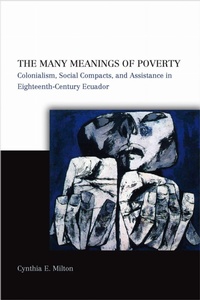
The Many Meanings of Poverty
Colonialism, Social Compacts, and Assistance in Eighteenth-Century Ecuador
Published on 7. September 2007
Book
Hardback
384 pages
978-0-8047-5178-0 (ISBN)
Description
This book analyzes the diverse understandings of poverty in a multiracial colonial society, eighteenth-century Quito. It shows that in a colonial world both a pauper and a landowner could lay claim to assistance as the "deserving poor" while the vast majority of the impoverished Andean population did not share the same avenues of poor relief. The Many Meanings of Poverty asks how colonialism shaped arguments about poverty-such as the categories of "deserving" and "undeserving" poor-in multiracial Quito, and forwards three central observations: poverty as a social construct (based on gender, age, and ethnoracial categories); the importance of these arguments in the creation of governing legitimacy; and the presence of the "social" and "economic" poor. An examination of poverty illustrates changing social and religious attitudes and practices towards poverty and the evolution of the colonial state during the eighteenth-century Bourbon reforms.
Reviews / Votes
"This makes Quito, I think, the ideal setting for Cynthia Milton's welcome exploration of what poverty meant in late colonial Spanish America The Many Meanings of Poverty is clearly a major contribution to the historiography of colonial Ecuador, which after years of neglect has attracted innovative work in areas such as gender, law, and demography." - The Journal of Latin American Studies "The reach and ramifications of this book are broad. It is one of several new works that assess the social impact of the Bourbon reforms, and, by opening the doors to Quito's poor house, it contributes to reinvigorated institutional histories of Latin America... To write a history of poverty in colonial Spanish America is a truly ambitious endeavor. The Many Meanings of Poverty is a valiant attempt at this monumental task, and the only word to describe many of its findings is: rich." - Bianca Premo (Florida International University, Eighteenth-Century Studies) "Cynthia E. Milton's book ... adds an additional layer of explanation to Egas's interpretation of who comprised the 'truly poor.' In a richly detailed and throughly researched scrutiny of the various faces of poverty in late colonial Quito, Milton examines how society drew distinctions between the deserving and not-so-deserving poor." - March Becker (H-Net Reviews)More details
Edition
New edition
Language
English
Place of publication
Palo Alto
United States
Target group
College/higher education
Edition type
New edition
Product notice
Cloth
Illustrations
14 tables, 4 figures, 10 illustrations, 3 maps
Dimensions
Height: 233 mm
Width: 183 mm
Thickness: 26 mm
Weight
653 gr
ISBN-13
978-0-8047-5178-0 (9780804751780)
Copyright in bibliographic data and cover images is held by Nielsen Book Services Limited or by the publishers or by their respective licensors: all rights reserved.
Schweitzer Classification
Person
Cynthia E. Milton is Canada Research Chair in Latin American History at the Universite de Montreal. She is coeditor of The Art of Truthtelling about Authoritarian Rule (2005)
Content
@fmct:Contents @toc4:List of Illustrations 000 Acknowledgments 000 Preface 000 @toc2:Introduction Colonialism, Social Compacts, and the Taxonomy of Poverty 1 @toc1:Part One The City and People of Quito @toc2:1. The City of Quito 000 2. Living on the Edge: Survival Strategies of the Urban Poor 000 @toc1:Part Two Society of Compacts: The Social Poor @toc2:3. Defining the "Solemn Poor": Wordplay and Petitions of Poverty in Colonial Quito, 16781782 000 4. Prostrate before the Feet of the King: Widows, Widowhood, Pensions, and Colonial Compacts 000 @toc1:Part Three Society of Compacts: The Economic Poor @toc2:5. Children on the Fringe of Empire: The Limits and Uses of Juvenile Welfare 000 6. Putting the Colonial (Poor) House in Order: The Wretched Poor and the Bourbon State 000 @toc1:Part Four When Societies Meet: The Blurring of Social Compacts @toc2:7. Shifting Compacts of the Traditional Poor: Widows as Viudas and as Pobres 000 8. The Broadening and Narrowing of the Solemn Poor: Poor Spaniards, the Wretched, and Collapsing Privileges, 17831800 000 Conclusion The Erosion of Charity, Boundaries, and Colonial Compacts 000 @toc4:Appendix 000 Glossary 000 Notes 000 Bibliography 000 Index 000