

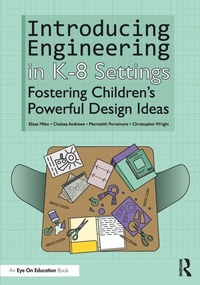
Introducing Engineering in K-8 Settings
Fostering Children's Powerful Design Ideas
1st Edition
Published on 3. February 2025
Book
Paperback/Softback
250 pages
978-1-032-42987-8 (ISBN)
Description
Introducing Engineering to K-8 Students will provide you with the tools you need to incorporate engineering design into your classroom. Rather than prescribing a specific curriculum to follow, this book will help you engage your students with hands-on, open-ended engineering design problems that can be easily integrated into your existing classroom setup.
Beginning with the basics of K-8 engineering, and advancing to topics such as integrating engineering with other disciplines, documentation, and assessments, the chapters provide a how-to on creating open-ended engineering activities, design tasks, and projects that are reflective of the academic, social, emotional, developmental, and community goals of your students. An additional focus is on ways to adapt these pedagogical approaches to meet the needs of all students, representative of racially, ethnically, socioeconomically, and gender diverse populations and students who receive special education services. Case studies and practical implementation strategies are presented alongside more than fifteen lesson plans, with tips on how to modify the tasks presented in the book to work with your classroom and students. This user-centered approach will also help you create your own engineering lessons that meet your individual classroom objectives and interests, and be able to recognize and classify your students' engineering behaviors to support them in enacting their ideas.
No matter your experience or comfort level, this book will be an invaluable resource for elementary and middle school science and technology teachers at all career stages who are looking to introduce engineering design to their students.
Additional classroom resources can be found online at introducingengineering.org.
Beginning with the basics of K-8 engineering, and advancing to topics such as integrating engineering with other disciplines, documentation, and assessments, the chapters provide a how-to on creating open-ended engineering activities, design tasks, and projects that are reflective of the academic, social, emotional, developmental, and community goals of your students. An additional focus is on ways to adapt these pedagogical approaches to meet the needs of all students, representative of racially, ethnically, socioeconomically, and gender diverse populations and students who receive special education services. Case studies and practical implementation strategies are presented alongside more than fifteen lesson plans, with tips on how to modify the tasks presented in the book to work with your classroom and students. This user-centered approach will also help you create your own engineering lessons that meet your individual classroom objectives and interests, and be able to recognize and classify your students' engineering behaviors to support them in enacting their ideas.
No matter your experience or comfort level, this book will be an invaluable resource for elementary and middle school science and technology teachers at all career stages who are looking to introduce engineering design to their students.
Additional classroom resources can be found online at introducingengineering.org.
More details
Language
English
Place of publication
London
United Kingdom
Publishing group
Taylor & Francis Ltd
Target group
Professional and scholarly
Professional
Illustrations
73 s/w Abbildungen, 36 s/w Photographien bzw. Rasterbilder, 37 s/w Zeichnungen, 27 s/w Tabellen
27 Tables, black and white; 37 Line drawings, black and white; 36 Halftones, black and white; 73 Illustrations, black and white
Dimensions
Height: 254 mm
Width: 178 mm
Thickness: 14 mm
Weight
489 gr
ISBN-13
978-1-032-42987-8 (9781032429878)
Copyright in bibliographic data and cover images is held by Nielsen Book Services Limited or by the publishers or by their respective licensors: all rights reserved.
Schweitzer Classification
Other editions
Additional editions

Elissa Milto | Chelsea Andrews | Merredith Portsmore
Introducing Engineering in K-8 Settings
Fostering Children's Powerful Design Ideas
Book
02/2025
1st Edition
Routledge
€174.60
Shipment within 10-20 days
Elissa Milto | Chelsea Andrews | Merredith Portsmore
Introducing Engineering in K-8 Settings
Fostering Children's Powerful Design Ideas
E-Book
12/2024
1st Edition
Routledge
€23.49
Available for download
Elissa Milto | Chelsea Andrews | Merredith Portsmore
Introducing Engineering in K-8 Settings
Fostering Children's Powerful Design Ideas
E-Book
12/2024
1st Edition
Routledge
€23.49
Available for download
Persons
Elissa Milto is the Director of Outreach at Tufts Center for Engineering Education and Outreach, USA.
Chelsea Andrews is a research assistant professor at Tufts Center for Engineering Education and Outreach, USA.
Merredith Portsmore serves as the Director of Tufts Center for Engineering Education and Outreach and as a research associate professor, USA.
Christopher Wright is an associate professor in the School of Education at Drexel University, USA.
Chelsea Andrews is a research assistant professor at Tufts Center for Engineering Education and Outreach, USA.
Merredith Portsmore serves as the Director of Tufts Center for Engineering Education and Outreach and as a research associate professor, USA.
Christopher Wright is an associate professor in the School of Education at Drexel University, USA.
Content
1. An Introduction to Engineering in K-8 2. Engineering and Children's Powerful Designs 3. Children's Engineering: Knowledge, Skills, and Engagement 4. The Responsive Engineering Classroom 5. Engineering Activities: What Counts as Engineering? 6. Getting Engineering Started in Your Classroom 7. A First Step-A Beginning Classroom Activity 8. Getting Started with Engineering: Sample Introductory Activities 9. Writing and Drawing to Support Engineering Thinking 10. Facilitating Engineering Conversations 11. Inclusive and Connected Engineering Classrooms 12. Choosing Materials and Building 13. Assessment 14. Engineering Design Activity Sequences Appendices 1. Classroom Resources 2. Lesson Plans 3. Supporting Content