

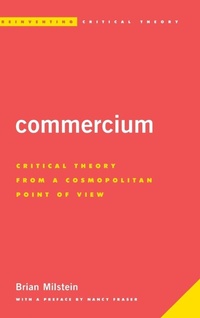
Commercium
Critical Theory From a Cosmopolitan Point of View
Published on 30. October 2015
Book
Hardback
328 pages
978-1-78348-283-2 (ISBN)
Description
Since the end of the Cold War, there has been a wealth of discussion and controversy about the idea of a 'postnational' or 'cosmopolitan' politics. But while there are many normative theories of cosmopolitanism, as well as some cosmopolitan theories of globalization, there has been little attempt to grapple systematically with fundamental questions of structure and action from a 'cosmopolitan point of view.' Drawing on Kant's cosmopolitan writings and Habermas's critical theory of society, Brian Milstein argues that, before we are members of nations or states, we are participants in a 'commercium' of global interaction who are able to negotiate for ourselves the terms on which we share the earth in common with one another. He marshals a broad range of literature from philosophy, sociology, and political science to show how the modern system of sovereign nation-states destructively constrains and distorts these relations of global interaction, leading to pathologies and crises in present-day world society.
Reviews / Votes
Frankfurt critical theorists have had much to say in the last two decades about globalization. Yet Brian Milstein's creative new book takes many of the debates at hand to new and higher intellectual levels. Offering creative rereadings of Kant and many other important cosmopolitan theorists, Milstein treads where many contemporary critical theorists have feared to tread: the harsh realities of our violence-prone international or interstate political system. This is an important contribution to international political and social theory. -- William E. Scheuerman, Indiana University In his original and important contribution to the debate about cosmopolitanism, Brian Milstein uses Kant's concept of "commercium" to reconstruct the many ways in which we already live in a globalized world. But one, as Milstein shows with great clarity, in which we have not yet found the legal and political forms for organizing this life in a justifiable way. This book shows the power of a critical theory that combines normative and sociological reflection. A great achievement. -- Rainer Forst, Professor of Political Theory and Philosophy, Goethe Universitaet, FrankfurtMore details
Series
Language
English
Place of publication
United Kingdom
Publishing group
Bloomsbury Publishing PLC
Target group
Professional and scholarly
US School Grade: From College Senior to College Graduate Student
Dimensions
Height: 235 mm
Width: 157 mm
Thickness: 24 mm
Weight
685 gr
ISBN-13
978-1-78348-283-2 (9781783482832)
Copyright in bibliographic data and cover images is held by Nielsen Book Services Limited or by the publishers or by their respective licensors: all rights reserved.
Schweitzer Classification
Other editions
Additional editions
E-Book
10/2015
1st Edition
Rowman & Littlefield Publishers
€49.99
Available for download
E-Book
10/2015
1st Edition
Rowman & Littlefield Publishers
€49.99
Available for download
Persons
Brian Milstein is a postdoctoral research fellow at the Goethe University Frankfurt. He completed his PhD at the New School for Social Research, where his dissertation was awarded the Hannah Arendt Award in Politics, and he has published articles in the European Journal of Philosophy and the European Journal of Political Theory.
Content
Preface, Nancy Fraser / Introduction: Idea for a Critical Theory Conceived with a Cosmopolitan Intention / Part I: Habermas's Critical Theory of Society / 1. The Theory of Communicative Action / 2. The Postnational Constellation / Part II: Lifeworld and Commercium / 3. Kant, Commercium and the Cosmopolitan Problematic / 4. The 'Boundaries' of the Lifeworld / 5. Commercium Beyond Kant / Part III: The Demospathic State and the International System / 6. Systematic Approaches to International Relations / 7. Between Functionalism and Path-Dependence / 8. The Reifying Effects of Reciprocal Force / Part IV: The Tasks of a Critical Theory Conceived with a Cosmopolitan Intention / 9. Critique and Crisis in World Society / Bibliography / Index