

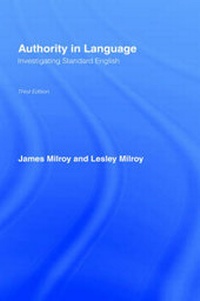
Authority in Language
Investigating Standard English
3rd Edition
Published on 12. November 1998
Book
Hardback
188 pages
978-0-415-17412-1 (ISBN)
Description
This book has a great track record; of its kind its the best on the market. - Deborah Cameron, University of Strathclyde
This influential and widely used book has been extensively revised and includes a new chapter on linguistic discrimination on the basis of class, race and ethnicity. Other topics covered include:
* National Curriculum and arguments about linguistic correctness *
* new varieties of English (including African American English)
* attitudes to language
These revisions ensure Authority in Language remains topical and up-to-date.
This influential and widely used book has been extensively revised and includes a new chapter on linguistic discrimination on the basis of class, race and ethnicity. Other topics covered include:
* National Curriculum and arguments about linguistic correctness *
* new varieties of English (including African American English)
* attitudes to language
These revisions ensure Authority in Language remains topical and up-to-date.
More details
Edition
3rd New edition
Language
English
Place of publication
London
United Kingdom
Publishing group
Taylor & Francis Ltd
Target group
College/higher education
Undergraduate
Edition type
New edition
Illustrations
5 s/w Tabellen
5 Tables, black and white
Dimensions
Height: 229 mm
Width: 152 mm
Weight
430 gr
ISBN-13
978-0-415-17412-1 (9780415174121)
Copyright in bibliographic data and cover images is held by Nielsen Book Services Limited or by the publishers or by their respective licensors: all rights reserved.
Schweitzer Classification
Other editions
Additional editions
Book
11/1998
3rd Edition
Routledge
€53.41
Article exhausted; check different version
Previous edition

James Milroy | Lesley Milroy
Authority in Language
Investigating Language Standardisation and Prescription
Book
04/1987
2nd Edition
Routledge
€38.56
No shipping information available
Content
Preface. Preface to the second edition. Key to symbols and abbreviations used in the text. 1. Prescription and standardisation 1.1 Language prescription and its consequences 1.2 Lingusitics and prescription 1.3 Attitudes to language 1.4 Languages standardisation 2. Standard English and the complaint tradition 2.1 The history of Standard English 2.2 The function of language complaints in maintaining the standard 2.3 Correctness and semantic shift 2.4 George Orwell and the moralistic tradition 2.5 Standardisation and the teaching of literacy 2.6 Conclusions 3. Spoken and written norms 3.1 Introduction 3.2 Language change and language maintenance 3.3 Spoken English and the effects of literacy 3.4 The spoken and written channels 3.5 Conclusions 4. Grammar and speech 4.1 Introduction 4.2 Prescription and spoken language 4.3 Prescription and contextual variability in speech 4.4 The grammar of Non-Standard English 4.5 Conclusion 5. Linguistic prescription and the speech community 5.1 Introduction 5.2 The social distribution of linguistic variants 5.3 Some common prescriptions: a critique 5.4 A wider perspective on prescriptivism 5.5 Group identity and language variation 5.6 Conclusion 6. Linguistic repertoires and communicative competence 6.1 Introductory 6.2 Communicative competence 6.3 Types of linguistic repertoire 6.4 Some practical considerations 6.5 Observing and analysing linguistic repertoires 6.6 Conclusion 7. 'Planned' and 'unplanned' speech events 7.1 Spoken and written language 7.2 Planned and unplanned discourse 7.3 The discourse of structure of interviews 7.4 Applying sociolinguistic principles to test situations: an example 7.5 Some wider implications 7.6 Conclusion 8. Some practical implications of prescriptivism: the linguistic adequacy of language assessment procedures 8.1 Introduction 8.2 Linguistic critiques of language tests: the question of linguistic realism 8.3 Linguistic critiques of language tests: the question of cultural linguistic bias 8.4 Concluding remarks Coda. Bibliography. Index