

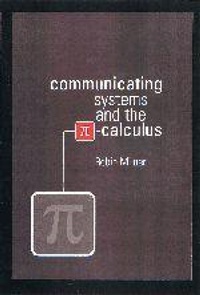
Communicating and Mobile Systems
The Pi Calculus
Published on 20. May 1999
Book
Hardback
176 pages
978-0-521-64320-7 (ISBN)
Description
The pi-calculus differs from other models of communicating behaviour mainly in its treatment of mobility. The movement of a piece of data inside a computer program is treated exactly the same as the transfer of a message - or indeed an entire computer program - across the internet. One can also describe networks which reconfigure themselves. The calculus is very simple but powerful; its most prominent ingredient is the notion of a name. Its theory has two important ingredients: the concept of behavioural (or observational) equivalence, and the use of a new theory of types to classify patterns of interactive behaviour. The internet, and its communication protocols, fall within the scope of the theory just as much as computer programs, data structures, algorithms and programming languages. This book is the first textbook on the subject; it has been long-awaited by professionals and will be welcomed by them, and their students.
Reviews / Votes
'... may well become the standard work on the ?-calculus.' Martin Hoffman, Zentralblatt MATHMore details
Language
English
Place of publication
Cambridge
United Kingdom
Target group
Professional and scholarly
College/higher education
Illustrations
Worked examples or Exercises; 58 Line drawings, unspecified
Dimensions
Height: 235 mm
Width: 157 mm
Thickness: 14 mm
Weight
415 gr
ISBN-13
978-0-521-64320-7 (9780521643207)
Copyright in bibliographic data and cover images is held by Nielsen Book Services Limited or by the publishers or by their respective licensors: all rights reserved.
Schweitzer Classification
Other editions
Additional editions
Book
05/1999
Cambridge University Press
€77.70
Shipment within 15-20 days
Person
Content
Glossary; Part I. Communicating Systems: 1. Introduction; 2. Behaviour of automata; 3. Sequential processes and bisimulation; 4. Concurrent processes and reaction; 5. Transitions and strong equivalence; 6. Observation equivalence: theory; 7. Observation equivalence: examples; Part II. The ?-Calculus: 8. What is mobility? 9. The ?-calculus and reaction; 10. Applications of the ?-calculus; 11. Sorts, objects and functions; 12. Commitments and strong bisimulation; 13. Observation equivalence and examples; 14. Discussion and related work; Bibliography; Index.