

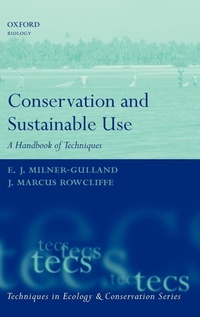
Conservation and Sustainable Use
A Handbook of Techniques
Published on 15. November 2007
Book
Hardback
324 pages
978-0-19-853036-7 (ISBN)
Description
The relentless exploitation and unsustainable use of wildlife, whether for food, medicine or other uses, is a key concern for conservationists worldwide. Indeed, wildlife conservation and sustainable use have recently become centrepieces in conservation and development research. Assessment, interpretation and ultimate action in a scientific study of exploited species must consider numerous factors: from the biology, habitat requirements and population dynamics of the species in question to the relationships that people have with their environment and the species within it. Any long-term management plan must ensure that people and wildlife can coexist - otherwise it is doomed to failure.
Conservation and Sustainable Use provides a practical and integrated approach to carrying out research on the conservation of exploited species. It is relevant to both tropical and temperate biomes and is applicable to all exploited species, including mammals, fish and plants. It describes both the practical (field) and theoretical (modelling) techniques for obtaining and interpreting information, integrating biological, social, economic and institutional analyses. It also demonstrates how to translate information into effective action through appropriate interventions, from legislation to changing people's attitudes. This is the first time that all these issues have been covered together in a single, practically-orientated volume.
This book will be essential reading for graduate level students and researchers in conservation biology, human ecology, sociology and resource economics. It will also provide an important reference for anyone who is interested in carrying out a scientifically-based conservation programme for an exploited species, including field biologists, wildlife managers and practitioners in the fields of conservation and international development.
Conservation and Sustainable Use provides a practical and integrated approach to carrying out research on the conservation of exploited species. It is relevant to both tropical and temperate biomes and is applicable to all exploited species, including mammals, fish and plants. It describes both the practical (field) and theoretical (modelling) techniques for obtaining and interpreting information, integrating biological, social, economic and institutional analyses. It also demonstrates how to translate information into effective action through appropriate interventions, from legislation to changing people's attitudes. This is the first time that all these issues have been covered together in a single, practically-orientated volume.
This book will be essential reading for graduate level students and researchers in conservation biology, human ecology, sociology and resource economics. It will also provide an important reference for anyone who is interested in carrying out a scientifically-based conservation programme for an exploited species, including field biologists, wildlife managers and practitioners in the fields of conservation and international development.
Reviews / Votes
...provides a practical and integrated approach to carrying out research on the conservation of exploited species of any kind. * Institute of Zoology * '...fills an important gap and assembles a great deal of valuable information of interest to readers of Sustainable. One of the merits of the book is its clarity.' Sustainable, December 2007.More details
Series
Language
English
Place of publication
Oxford
United Kingdom
Target group
College/higher education
Graduate level students and researchers in the conservation biology, field biologists and wildlife managers. There is also a significant global market amongst conservation NGOs, resource managers and international developers who will use the book as a field manual. A secondary market exists amongst sociologists, human ecologists and economists.
Illustrations
37 line and 29 halftone illustrations
Dimensions
Height: 240 mm
Width: 161 mm
Thickness: 22 mm
Weight
652 gr
ISBN-13
978-0-19-853036-7 (9780198530367)
Copyright in bibliographic data and cover images is held by Nielsen Book Services Limited or by the publishers or by their respective licensors: all rights reserved.
Schweitzer Classification
Other editions
Additional editions
Book
11/2007
Oxford University Press
€96.80
Shipment within 15-20 days
Persons
E.J. Milner-Gulland is a Reader in Conservation Science in the Division of Biology, Silwood Park, Imperial College London. Her first degree was in Pure and Applied Biology at Oxford University, and she did her PhD in bioeconomics and conservation at Imperial College. She held a Junior Research Fellowship at New College, Oxford, and then was an NSERC/Royal Society visiting researcher at the University of British Columbia. She held a lectureship in Mathematical Ecology at the University of Warwick, and then a lectureship in Resource Economics at Imperial College. She has published 60 articles in peer-reviewed journals, 1 book and several book chapters, and takes an inter-disciplinary approach to the interactions between the population dynamics of exploited species and the incentives faced by those who use them.
J.M. Rowcliffe is a Research Fellow at the Institute of Zoology, Zoological Society of London. His first degree was in Biology of Plants and Animals at the University of Newcastle upon Tyne, and his PhD was on the population and behavioural ecology of plant-herbivore interactions at the University of East Anglia. Following his studies, he worked as a research officer at the Wildfowl and Wetlands Trust, where he specialised in applied waterfowl ecology, before moving to the Institute of Zoology, where he founded and now co-directs the IoZ Bushmeat Research Programme. He has published 45 articles in peer-reviewed journals and five book chapters.
J.M. Rowcliffe is a Research Fellow at the Institute of Zoology, Zoological Society of London. His first degree was in Biology of Plants and Animals at the University of Newcastle upon Tyne, and his PhD was on the population and behavioural ecology of plant-herbivore interactions at the University of East Anglia. Following his studies, he worked as a research officer at the Wildfowl and Wetlands Trust, where he specialised in applied waterfowl ecology, before moving to the Institute of Zoology, where he founded and now co-directs the IoZ Bushmeat Research Programme. He has published 45 articles in peer-reviewed journals and five book chapters.
Content
1. Introduction ; 2. Techniques for surveying exploited species ; 3. Understanding natural resource users' incentives ; 4. Assessing current sustainability of use ; 5. Developing Predictive Models ; 6. Choosing management approaches ; 7. Implementing management for long-term sustainability