

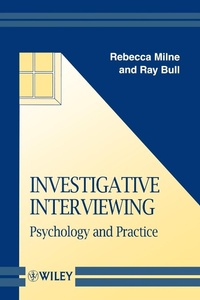
Investigative Interviewing
Psychology and Practice
1st Edition
Published on 28. June 1999
Book
Paperback/Softback
240 pages
978-0-471-98729-1 (ISBN)
Description
Well-informed and skilled interviewing is a key factor in dealingwith suspects, victims and witnesses. Experienced police andinvestigators know this from their own practice, and there is now asubstantial body of research and theory in psychology whichsupports this practice and can guide both training and thedevelopment of investigative work. The purpose of this book is toprovide a concise and clearly written guide to the psychologicalconcepts and research-based knowledge that can support and guideinvestigative interviewing. It deals in particular with:
* good basic practice and methods for investigativeinterviewing
* how to deal with false confessions and unreliable or incompletewitness information
* the special problems of interviewing children and othervulnerable people
* the process of interviewing suspects, victims, witnesses,complainants and colleagues
This book will be of interest and value to a wide range ofprofessionals involved in training and practice in the police orother agencies, as well as social workers,lawyers, psychologistsand psychiatrists involved in forensic work. "The strength of thisbook lies in its relevance for both practice and research ininvestigative interviewing, not only in Britain butinternationally. Based on psychological theory and research, itprovides practitioners with a wealth of information and specificguidelines to help improve their interviewing skills. Researchersare challenged to address some of the, as yet, unansweredquestions." Janet Jackson, Netherlands Institute for the Study ofCriminality and Law Enforcement, Leiden, The Netherlands This bookis published in the Wiley Series in the Psychology of Crime,Policing and Law Series Editors: professor Professor Graham DaviesUniversity of Leicester, UK, and Professor Ray Bull University ofPortsmouth, UK
* good basic practice and methods for investigativeinterviewing
* how to deal with false confessions and unreliable or incompletewitness information
* the special problems of interviewing children and othervulnerable people
* the process of interviewing suspects, victims, witnesses,complainants and colleagues
This book will be of interest and value to a wide range ofprofessionals involved in training and practice in the police orother agencies, as well as social workers,lawyers, psychologistsand psychiatrists involved in forensic work. "The strength of thisbook lies in its relevance for both practice and research ininvestigative interviewing, not only in Britain butinternationally. Based on psychological theory and research, itprovides practitioners with a wealth of information and specificguidelines to help improve their interviewing skills. Researchersare challenged to address some of the, as yet, unansweredquestions." Janet Jackson, Netherlands Institute for the Study ofCriminality and Law Enforcement, Leiden, The Netherlands This bookis published in the Wiley Series in the Psychology of Crime,Policing and Law Series Editors: professor Professor Graham DaviesUniversity of Leicester, UK, and Professor Ray Bull University ofPortsmouth, UK
Reviews / Votes
"... covers a huge area of research and knowledge." (Criminal Justice, Vol.1, No.3, 2001)"... an excellent source book.... " (Legal Criminological Psychology, September 2000)
"The timeliness of this book cannot be overstated in an investigative environment.... The topic of the book, then, is not just important it is vital. It is strongly recommended...." (Expert Evidence, Vol. 77, 1999)
More details
Series
Language
English
Place of publication
New York
United States
Target group
Professional and scholarly
Product notice
Paperback (trade)
Unsewn / adhesive bound
Dimensions
Height: 229 mm
Width: 152 mm
Thickness: 14 mm
Weight
396 gr
ISBN-13
978-0-471-98729-1 (9780471987291)
Copyright in bibliographic data and cover images is held by Nielsen Book Services Limited or by the publishers or by their respective licensors: all rights reserved.
Schweitzer Classification
Other editions
New editions
Book
11/2025
2nd Edition
Wiley
€69.50
Shipment within 15-20 days

Book
06/2006
Wiley
€37.13
Article not available
Persons
Becky Milne is Professor of Forensic Psychology and course leader of the FdA Investigation and Evidence and the FdA in Police Studies, distance learning programmes specifically for investigators and police officers respectively.
Content
Introduction: The Importance of Investigative Interviewing.
How do People Remember?
The Cognitive Interview.
Conversation Management.
What Happens in Police Interviews?
False Testimony.
Interviewing Vulnerable People.
Interviewing Children.
Training.
Conclusions and Future Developments.
References.
Index.
How do People Remember?
The Cognitive Interview.
Conversation Management.
What Happens in Police Interviews?
False Testimony.
Interviewing Vulnerable People.
Interviewing Children.
Training.
Conclusions and Future Developments.
References.
Index.