

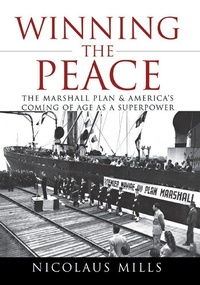
Winning the Peace
The Marshall Plan and America's Coming of Age as a Superpower
Published on 17. January 2008
Book
Hardback
304 pages
978-0-470-09755-7 (ISBN)
Description
In September 2003, President Bush announced before the United Nations General Assembly that he was prepared to make "the greatest financial commitment of its kind since the Marshall Plan" to help rebuild Iraq. Sixty years after Secretary of State George Marshall called on the United States to come to the aid of war-ravaged Europe, politicians of every stripe frequently invoke the Marshall Plan in support of programs aimed at using American wealth to extend the nation's power and influence, solve intractable third-world economic problems, and combat world hunger and disease. Do any of these impassioned advocates understand why the Marshall Plan succeeded where so many subsequent aid plans have failed, backfired, or produced only limited success?In Winning the Peace, historian Nicolaus Mills explores the Marshall Plan in all its dimensions to provide valuable lessons from the past about what America can and cannot do as a superpower.Mills emphasizes that from the very inception of his plan, Marshall was blunt about its costs, risks, and limited objectives. Marshall stated repeatedly that his policy would require sacrifices from the American people, mostly in the form of higher taxes, and that its purpose was solely to help stabilize shattered economies long enough for them to regain their pre-war vitality. Although he campaigned tirelessly for months to gain congressional and popular approval, Marshall never soft-peddled the burdens the plan would impose, nor oversold its potential benefits.One of the most distinctive features of the Marshall Plan, Mills argues, was the degree to which its beneficiaries were full partners in determining how American aid would be used and deciding when they were ready to move on to the next level. Marshall and the State Department remained flexible, even when the European nations scheduled to receive aid balked at being drawn into tighter cooperation with the United States than they were prepared for. Realizing that the rebirth of European economies was more important than any specific political, military, or diplomatic objective, the United States often scaled back its demands rather than jeopardize the Marshall Plan.Could the Marshall Plan serve as a useful template for future successful American foreign policy initiatives? Winning the Peace points out the crucial principles in George Marshall's plan that must be present in any successful aid effort, while emphasizing the need to base any contemporary plan on solid knowledge of the region involved, strong relationships with beneficiary nations, and a flexible approach to achieving limited and realistic goals. This insightful and sure-to-be-controversial study is important reading for anyone interested in American post-war history, foreign policy, and current international affairs.
More details
Language
English
Place of publication
Chichester
United Kingdom
Publishing group
Turner Publishing Company
Target group
Professional and scholarly
Product notice
Unsewn / adhesive bound
Paper over boards
With dust jacket
Dimensions
Height: 234 mm
Width: 166 mm
Thickness: 28 mm
Weight
508 gr
ISBN-13
978-0-470-09755-7 (9780470097557)
Copyright in bibliographic data and cover images is held by Nielsen Book Services Limited or by the publishers or by their respective licensors: all rights reserved.
Schweitzer Classification
Other editions
Additional editions
E-Book
01/2008
1st Edition
Trade Paper Press
€15.49
Available for download
Person
NICOLAUS MILLS is a professor of American Studies at Sarah Lawrence College, an editorial board member of Dissent, and a contributor to the American Prospect, the New York Times, and the Los Angeles Times.