

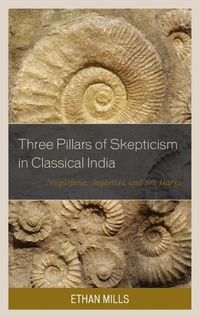
Three Pillars of Skepticism in Classical India
Nagarjuna, Jayarasi, and Sri Harsa
Published on 15. September 2018
Book
Hardback
254 pages
978-1-4985-5569-2 (ISBN)
Description
Beginning with the earliest strata of Indian philosophy, this book uncovers a distinct tradition of skepticism in Indian philosophy through a study of the "three pillars" of Indian skepticism near the beginning, middle, and end of the classical era: Nagarjuna (c. 150-200 CE), Jayarasi (c. 770-830 CE), and Sri Har?a (c. 1125-1180 CE). Moving beyond the traditional school model of understanding the history of Indian philosophy, this book argues that the philosophical history of India contains a tradition of skepticism about philosophy represented most clearly by three figures coming from different schools but utilizing similar methods: Nagarjuna, Jayarasi, and Sri Har?a. This book argues that there is a category of skepticism often overlooked by philosophers today: skepticism about philosophy, varieties of which are found not only in classical India but also in the Western tradition in Pyrrhonian skepticism. Skepticism about philosophy consists of intellectual therapies for those afflicted by the quest for dogmatic beliefs. The book begins with the roots of this type of skepticism in ancient India in the ?g Veda, Upani?ads, and early Buddhist texts. Then there are two chapters on each of the three major figures: one chapter giving each philosopher's overall aims and methods and a second demonstrating how each philosopher applies these methods to specific philosophical issues. The conclusion shows how the history of Indian skepticism might help to answer philosophy's detractors today: while skeptics demonstrate that we should be modest about philosophy's ability to produce firm answers, philosophy nonetheless has other uses such as cultivating critical thinking skills and lessening dogmatism. This book is situated within a larger project of expanding the history of philosophy. Just as the history of Western philosophy ought to inform contemporary philosophy, so should expanding the history of philosophy to include classical India illuminate understandings of philosophy today: its value, limits, and what it can do for us in the 21st century.
Reviews / Votes
"Three Pillars of Skepticism in Classical India: Nagarjuna, Jayarasi and Sri Harsa", is truly a valuable addition to the publications on Indian philosophy. Even if an advanced reader may later discover that what the three pillars--Nagarjuna, Jayarasi and Sri Harsa--support is not necessarily constructed of skepticism bricks, the path to the discovery via Ethan Mills' road-signs and guideposts, most engaging to read, is worth it all. * Philosophy East and West * The Three Pillars is engagingly written. Mills brings his audience into Indian philosophy by making connections to contemporary Anglo-European philosophy, as well as global philosophies. The book is clear and engaging. * Journal of Dharma Studies * The Three Pillars is engagingly written. . . Mills' attention to shared methodologies and concerns is a welcome contribution to the ongoing correction to that division. Further, Three Pillars considers connections among thinkers beyond India (in Greece, Persia, and China). This global vantage point is a welcome aspect to the book, taking it beyond a simple Indian/"Western" framework. . . . [B]y drawing our attention to similarities among such disparate thinkers, Mills has done an important service to philosophers interested in global epistemologies. The book is clear and engaging. . . new-comers to Indian philosophy will find the book a useful, if controversial, introduction to three important thinkers. Three Pillars of Skepticism in Classical India should spur further inquiry into each of the three "pillars" and their relationship to philosophy in premodern South Asia and the rest of the world." * Journal of Dharma Studies * Ethan Mills has written a lovely book on Indian skepticism. It shows that skepticism is not merely a Greek phenomenon, but enjoys a long history in India. This book addresses skepticism both in the orthodox and Buddhist traditions, and enriches our understanding of the interaction between those traditions and the development of philosophical dialectics in India. The account is erudite, nuanced, full of good translation and exposition. It is philosophically sophisticated, and easy to read. Anyone interested in skepticism or in Indian philosophy should read it. -- Jay Garfield, Smith College This book offers thought-provoking interpretations of three major figures in Indian thought. With technical precision, careful translation, and most notably, insightful comparisons with Western discussions, Mills makes an impressive and persuasive case for 'expanding the history of philosophical skepticism', and leads us to think afresh about the purposes and limits of doing philosophy today. -- Chakravarthi Ram-Prasad, Lancaster University Ethan Mills makes a strong case for the skeptical positions of Nagarjuna, Jayarasi and Sri Har?a, which according to him should be appreciated as forms of "skepticism about philosophy" rather than epistemological skepticism. This is something any lover of philosophy should take seriously. -- Pradeep Gokhale, Savitribai Phule Pune UniversityMore details
Series
Language
English
Place of publication
United States
Publishing group
Bloomsbury Publishing Plc
Target group
Professional and scholarly
Dimensions
Height: 235 mm
Width: 157 mm
Thickness: 20 mm
Weight
571 gr
ISBN-13
978-1-4985-5569-2 (9781498555692)
Copyright in bibliographic data and cover images is held by Nielsen Book Services Limited or by the publishers or by their respective licensors: all rights reserved.
Schweitzer Classification
Other editions
Additional editions
E-Book
09/2018
1st Edition
Lexington Books
€40.49
Available for download
Person
Ethan Mills is assistant professor of philosophy at the University of Tennessee at Chattanooga
Content
Introduction: Classical Indian Skepticism about Philosophy: Expanding the History of Philosophical Skepticism
Chapter 1: Skeptical Roots in Early Indian Philosophy: ?g Veda, Upani?ads, and Early Buddhist Texts
Chapter 2: Nagarjuna's Buddhist Skepticism: From Emptiness to the Pacification of Conceptual Proliferation
Chapter 3: Nagarjuna and the Cause of Skepticism
Chapter 4: Jayarasi's Carvaka Skepticism: Irreligious Skepticism about Philosophy
Chapter 5: Jayarasi and the Delightful Destruction of Buddhist Epistemology
Chapter 6: Sri Har?a's Advaita Skepticism: The Critique of Realism and the Possibility of Mysticism
Chapter 7: Sri Har?a on Knowledge, Existence, and the Limits of Philosophy
Conclusion: The History of Indian Skepticism and Mitigated Skepticism about Philosophy
Chapter 1: Skeptical Roots in Early Indian Philosophy: ?g Veda, Upani?ads, and Early Buddhist Texts
Chapter 2: Nagarjuna's Buddhist Skepticism: From Emptiness to the Pacification of Conceptual Proliferation
Chapter 3: Nagarjuna and the Cause of Skepticism
Chapter 4: Jayarasi's Carvaka Skepticism: Irreligious Skepticism about Philosophy
Chapter 5: Jayarasi and the Delightful Destruction of Buddhist Epistemology
Chapter 6: Sri Har?a's Advaita Skepticism: The Critique of Realism and the Possibility of Mysticism
Chapter 7: Sri Har?a on Knowledge, Existence, and the Limits of Philosophy
Conclusion: The History of Indian Skepticism and Mitigated Skepticism about Philosophy