

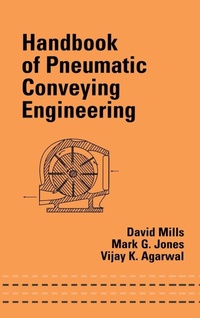
Handbook of Pneumatic Conveying Engineering
1st Edition
Published on 21. January 2004
Book
Hardback
720 pages
978-0-8247-4790-9 (ISBN)
Description
Pneumatic conveying systems offer enormous advantages: flexibility in plant layout, automatic operation, easy control and monitoring, and the ability to handle diverse materials, especially dangerous, toxic, or explosive materials. The Handbook of Pneumatic Conveying Engineering provides the most complete, comprehensive reference on all types and sizes of systems, considering their selection, design, maintenance, and optimization. It offers practical guidelines, diagrams, and procedures to assist with plant maintenance, operation, and control.
With well over fifty years of combined experience in the field, the authors promote practical, valuable approaches to test, evaluate, and correct both old and newly constructed systems. They include abundant checklists and approaches for preventing component wear, material degradation, and operating dilemmas and suggest lists of alternate materials and components to use if erosion does occur. Comparing various conveying system types, components, and flow mechanisms, the book explains the function of material flow, recommends conveying air velocity for different types of materials, and examines the conveying characteristics of a broad array of materials with emphasis on their impact on system performance.
Brimming with invaluable checklists, models, guidelines, diagrams, and illustrations, the Handbook of Pneumatic Conveying Engineering is simply the most authoritative guide to pneumatic conveying available and a critical tool for your everyday work.
With well over fifty years of combined experience in the field, the authors promote practical, valuable approaches to test, evaluate, and correct both old and newly constructed systems. They include abundant checklists and approaches for preventing component wear, material degradation, and operating dilemmas and suggest lists of alternate materials and components to use if erosion does occur. Comparing various conveying system types, components, and flow mechanisms, the book explains the function of material flow, recommends conveying air velocity for different types of materials, and examines the conveying characteristics of a broad array of materials with emphasis on their impact on system performance.
Brimming with invaluable checklists, models, guidelines, diagrams, and illustrations, the Handbook of Pneumatic Conveying Engineering is simply the most authoritative guide to pneumatic conveying available and a critical tool for your everyday work.
Reviews / Votes
"[The authors] cover the topic from every angle. ... The book includes many clearly-drawn figures ... that help the reader visualize the system. ... Recommended for college, university and technical schools as well as anyone involved in designing or building pneumatic conveying equipment."- E-Streams, Vol. 7, No. 12, Dec. 2004
More details
Series
Language
English
Place of publication
Bosa Roca
United States
Publishing group
Taylor & Francis Inc
Target group
Professional and scholarly
Professional
Dimensions
Height: 235 mm
Width: 157 mm
Thickness: 43 mm
Weight
1176 gr
ISBN-13
978-0-8247-4790-9 (9780824747909)
Copyright in bibliographic data and cover images is held by Nielsen Book Services Limited or by the publishers or by their respective licensors: all rights reserved.
Schweitzer Classification
Other editions
Additional editions
David Mills | Mark G. Jones | Vijay K. Agarwal
Handbook of Pneumatic Conveying Engineering
E-Book
01/2004
1st Edition
CRC Press
€489.99
Available for download
David Mills | Mark G. Jones | Vijay K. Agarwal
Handbook of Pneumatic Conveying Engineering
E-Book
01/2004
1st Edition
CRC Press
€489.99
Available for download
Persons
David Mills, Mark G. Jones, Vijay K. Agarwal
Content
Preface, 1. Types of Pneumatic Conveying Systems, 2. Feeding Devices, 3. System Components, 4. Gas-Solid Flows, 5. Air Requirements, 6. Air Only Data, 7. Conveyed Material Influences, 8. Pipeline Material, Orientation, and Bends, 9. Stepped Pipeline Systems, 10. Pneumatic Conveying of Coal and Ash, 11. Pneumatic Conveying of Food and Chemicals, 12. Pneumatic Conveying in the Aluminum Industry, 13. Conveying of Cement and Drilling Mud Powders, 14. Conveying of High Density and Other Materials, 15. System Design Using Conveying Data, 16. Quick Check Design Methods, 17. Innovatory Conveying Systems, 18. Fluidized Motion Conveying Systems, 19. Commissioning and Throughput Problems, 20. Erosive Wear Problems, 21. Material Degradation Problems, 22. Health and Safety Issues, 23. Pneumatic Conveying Test Facilities, Index